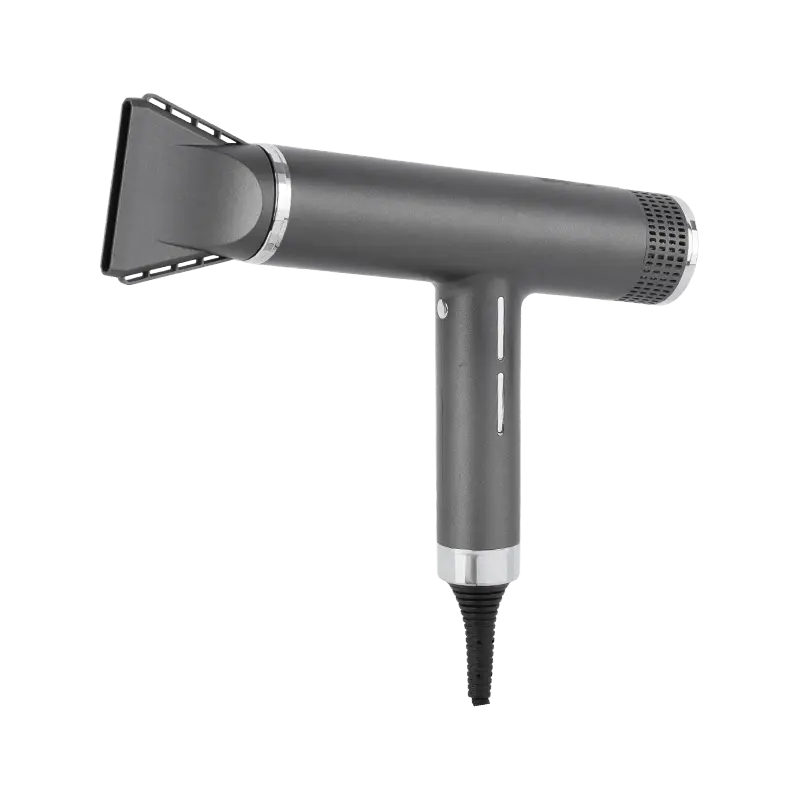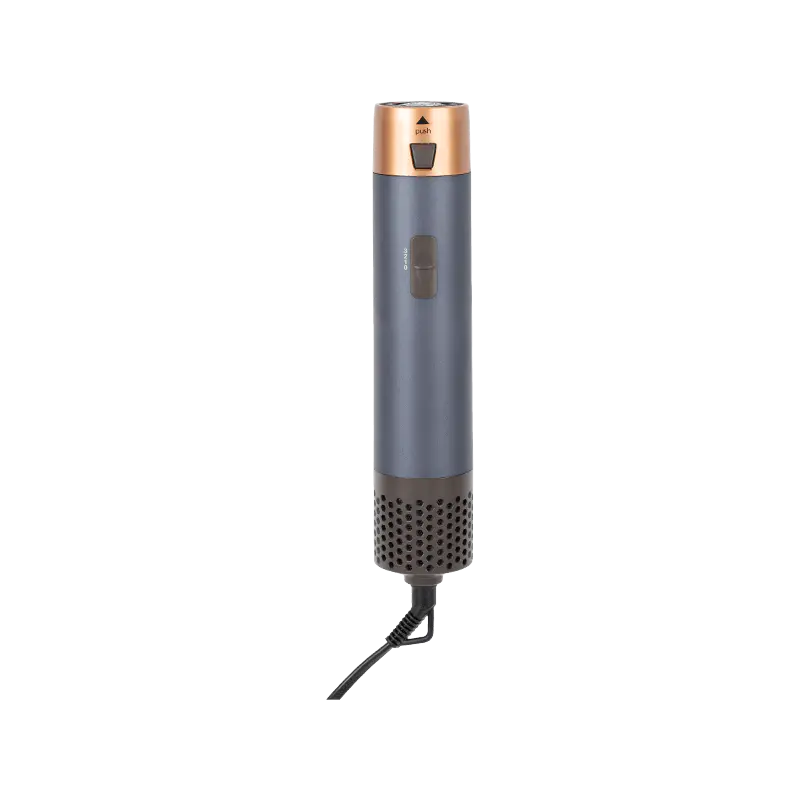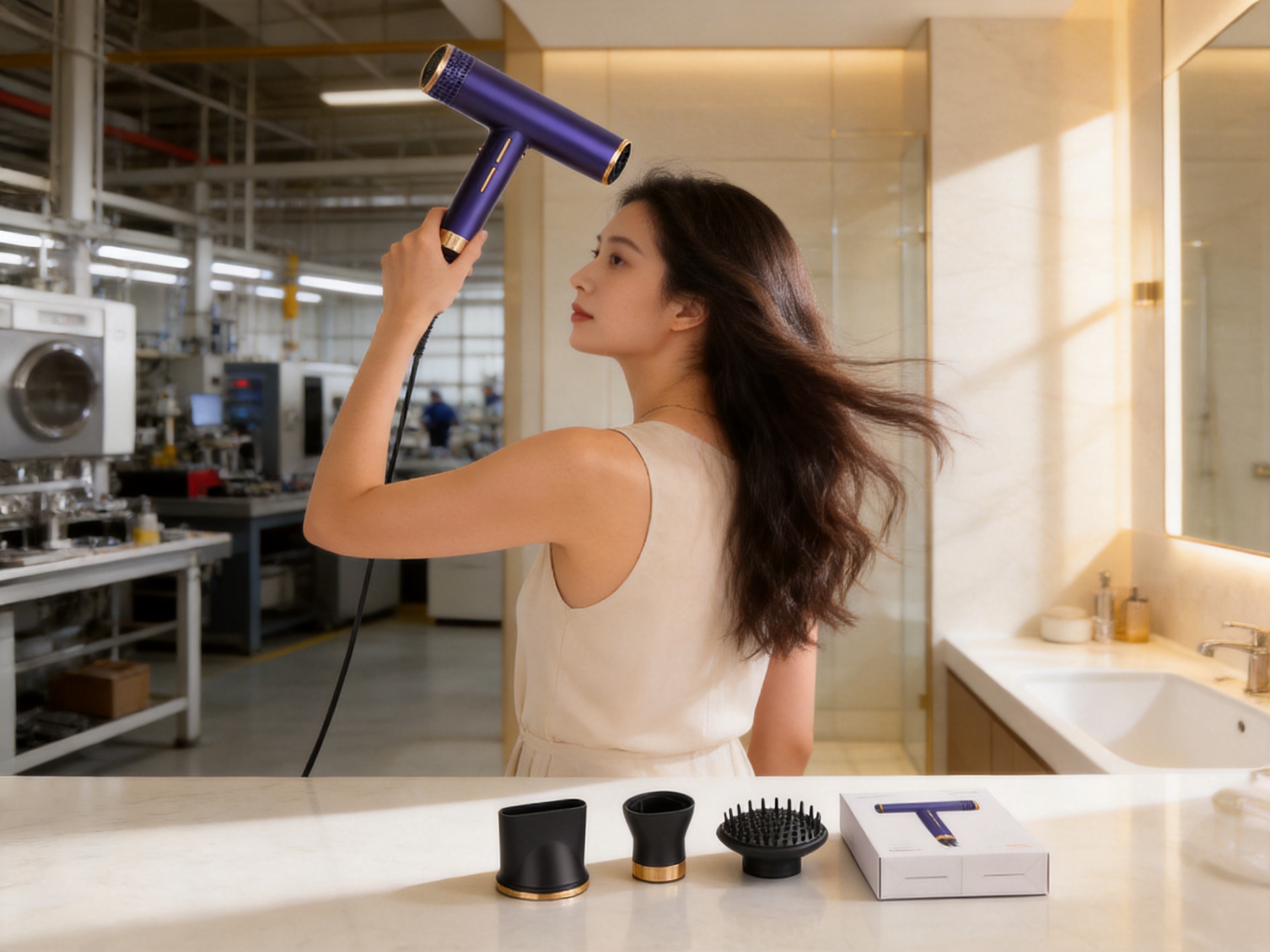
Hair dryers have evolved from basic heating appliances into sophisticated personal-care tools that combine high-speed airflow, intelligent controls, lightweight ergonomics, styling precision, and maintenance-focused engineering. The JYS-D20 Self-Cleaning Anti-Flyaway High-Speed Hair Dryer is designed around this modern standard. It brings together a high-speed brushless DC motor, intelligent self-cleaning, multiple airflow and temperature settings, dedicated cold-air control, a locking function, and a professional three-piece nozzle system in a compact body.
Developed for professional salons, premium home users, hospitality applications, and high-end retail programs, the JYS-D20 is positioned as more than a conventional hair dryer. Its design addresses several common problems associated with everyday drying: long drying times, excessive heat exposure, inconsistent control, accumulated dust, flyaways, wrist fatigue, and limited styling flexibility. Through a combination of high motor speed, intelligent electronic management, a detachable rear filter cover, and specialized accessories, the product is built to offer a more controlled and efficient drying experience.
The dryer is produced by SHAOXING BANGSHUO ELECTRICAL APPLIANCE CO., LTD., a Chinese manufacturer specializing in professional hair-care appliances and small electrical products. With experience in product development, OEM and ODM cooperation, international certifications, audited manufacturing operations, and large-scale production capacity, the company can support both standard product supply and customized commercial programs.
1. A New Generation of High-Speed Hair Drying
Traditional hair dryers commonly depend on relatively simple motor and heating structures. Although these products can provide acceptable results, many of them are heavier, louder, slower, or less adaptable than today’s consumers expect. Basic dryers may also offer limited temperature control, fixed airflow settings, and accessories that are difficult to attach or replace. In addition, a dryer’s internal filter can gradually collect dust and hair particles, reducing airflow and placing additional strain on the motor.
The JYS-D20 responds to these limitations with a design based on high-speed airflow and intelligent control. The brushless motor edition operates at approximately 110,000 revolutions per minute. This extremely high rotational speed helps generate strong airflow in a compact form factor, allowing users to dry hair rapidly while reducing the need to rely solely on excessive heat.
Fast airflow is important because drying performance depends on more than temperature. High-velocity air can help remove moisture efficiently from the surface of the hair, while controlled heat supports a comfortable and practical styling process. By balancing air movement with temperature selection, the JYS-D20 is intended to help users achieve fast results without treating maximum heat as the only solution.
The product is available in different motor and electrical configurations. The brushless version is specified at 1,500 watts for AC 120V, 60Hz markets and 1,800 watts for AC 220V–240V, 50–60Hz markets. A brush-motor version is also available in selected configurations, including 800W and 1,000W options with one speed and three temperature settings. This flexibility allows distributors, brands, salons, and retailers to choose a configuration that matches their target market, electrical standard, and positioning strategy.
Compared with many standard consumer hair dryers, the high-speed brushless version provides several potential advantages. Its motor architecture is designed for high rotational speed and efficient airflow generation. The brushless configuration also eliminates the conventional brushes used in many traditional motors, supporting a longer-term maintenance strategy and contributing to the product’s refined operating characteristics.
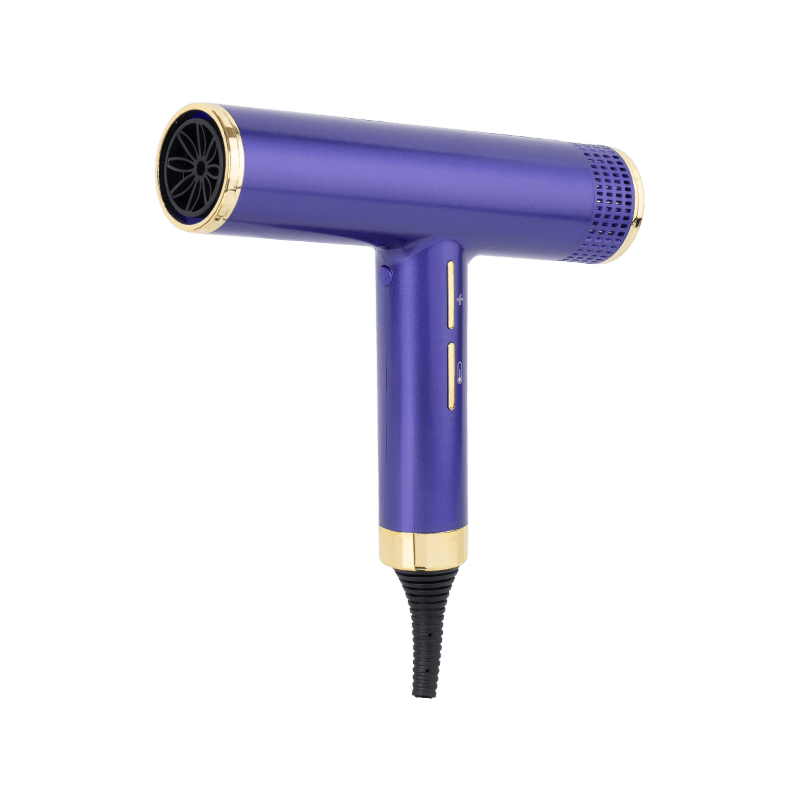
JYS-D20 Self-cleaning Anti-flyaway High-speed Hair Dryer
2. Brushless Motor Technology and Performance Advantages
The BLDC, or brushless direct-current, motor is one of the central technologies behind the JYS-D20. In a traditional brushed motor, physical brushes and a commutator transfer electrical energy to the rotating component. These parts experience mechanical contact and can gradually wear during use. A brushless motor uses electronic commutation instead, with the motor’s operation coordinated through an electronic control system.
For a hair dryer, brushless motor construction can offer meaningful design benefits. It allows the motor to operate at very high speed while reducing the mechanical friction associated with brush contact. The result is a compact motor capable of producing powerful airflow without requiring a large and heavy body. This supports the JYS-D20’s approximate brushless-version net weight of 310 grams.
The high-speed motor also contributes to the dryer’s professional positioning. Salon professionals often need to dry and style multiple clients during a working day. A motor that delivers strong airflow can reduce the time required for each service, while a lightweight body can make repeated use more comfortable. For home users, rapid drying can be especially valuable for thick, long, or moisture-retaining hair.
The JYS-D20’s motor speed is approximately 110,000 RPM in the brushless edition. This specification differentiates the dryer from many conventional products whose motors operate at substantially lower speeds. Motor speed alone does not determine final performance, since airflow design, heating control, electrical engineering, and nozzle geometry also matter. However, the combination of high rotational speed and a carefully designed airflow path can support the product’s fast-drying objective.
The brushless architecture may also support a smoother and more refined operating experience than many traditional brushed designs. The manufacturer presents the brushless version as suitable for users seeking quieter operation. Actual sound levels can vary according to voltage, airflow mode, nozzle selection, testing conditions, and the surrounding environment, but the motor design is intended to provide a more comfortable acoustic profile than basic high-speed brushed alternatives.
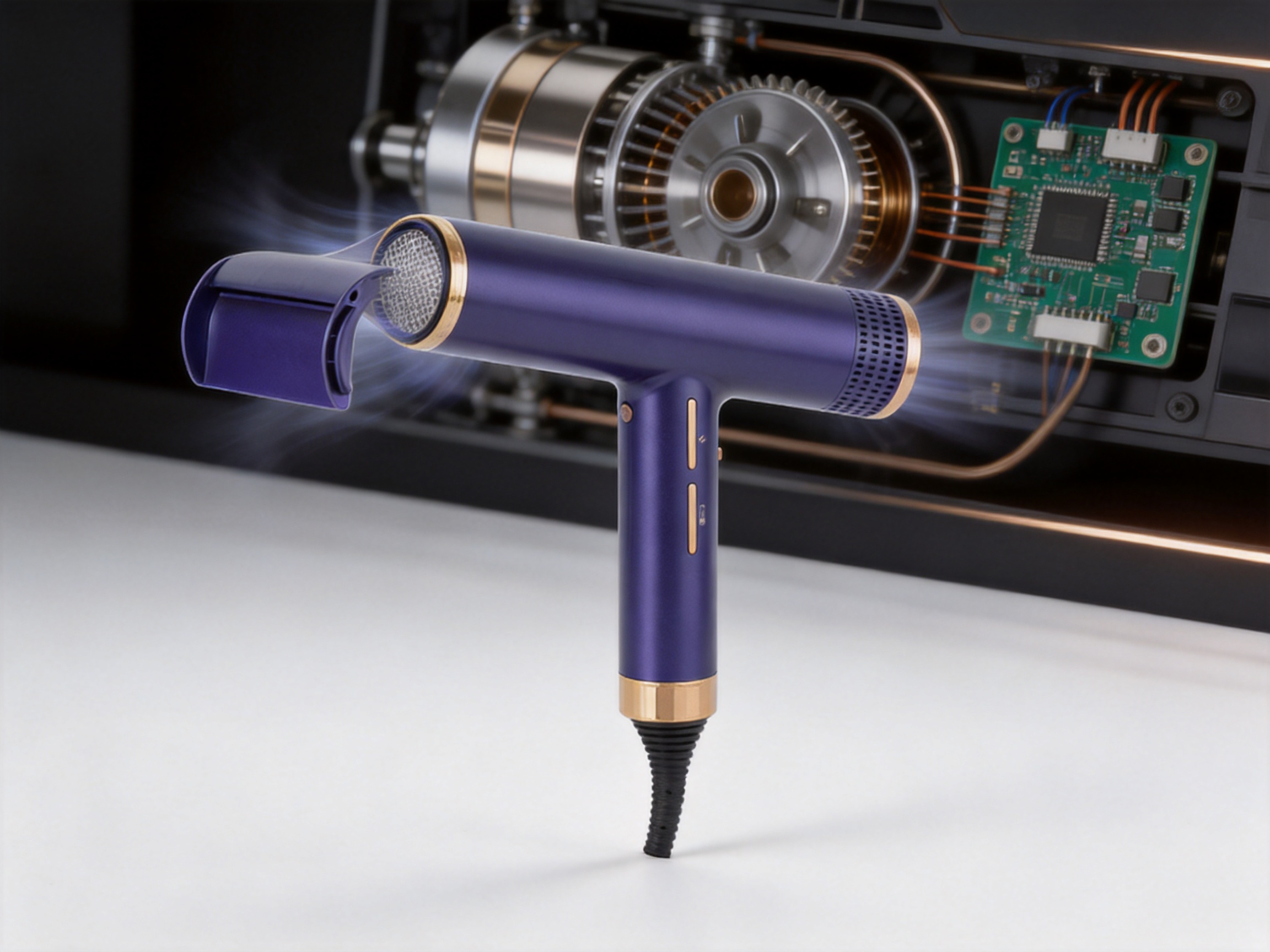
Another important advantage is motor-management precision. The JYS-D20 includes an internal PCBA, or printed circuit board assembly, that coordinates electrical power, motor operation, and temperature management. This electronic platform allows the product to integrate multiple controls in a compact body. It also supports the intelligent functions that distinguish the model from simpler dryers.
For importers and private-label brands, the availability of both brushless and brush-motor versions creates useful product-line flexibility. A brand may select the brushless version for a premium range and the brush version for a more cost-sensitive market. Both versions can be incorporated into a broader hair-care portfolio while maintaining a recognizable design direction.
3. Intelligent Self-Cleaning for Consistent Operation
One of the JYS-D20’s most distinctive features is its self-cleaning function. Hair dryers draw air through their rear intake area during operation. Over time, dust, lint, hair, and other small particles can accumulate around the filter and internal airflow path. If the intake area becomes restricted, the dryer may experience reduced airflow, increased operating stress, or inconsistent performance.
The JYS-D20 is designed to address this issue by automatically reversing the motor airflow during the self-cleaning cycle. The reverse airflow helps dislodge dust and debris from internal components and the filter area. This approach is more advanced than relying exclusively on manual cleaning, especially for users who may not remember to inspect the filter regularly.
Self-cleaning does not eliminate the need for routine care, but it can make maintenance easier and more effective. The product also features a detachable rear filter cover. Users can remove the cover, clean the net or filter area, and then reinstall it. This two-part maintenance system combines automatic airflow reversal with accessible manual cleaning.
For salons, the maintenance advantage is particularly relevant. Professional equipment may be used many times each day and exposed to styling products, loose hair, dust, and fibers. A filter that can be cleaned quickly helps operators maintain product hygiene and airflow performance. The self-cleaning function may also reduce the frequency of deep maintenance between routine inspections.
For home users, the feature provides an additional layer of convenience. Many people continue using a hair dryer without realizing that the intake filter has become obstructed. By helping remove accumulated particles and making the filter cover easy to access, the JYS-D20 encourages a more practical maintenance routine.
From a product-development perspective, the self-cleaning function demonstrates how the manufacturer has moved beyond basic heating and motor assembly. It reflects attention to the complete product life cycle: daily use, cleaning, performance stability, and long-term usability. This is an important competitive advantage in a market where many entry-level dryers offer powerful claims but limited maintenance support.
Recommended Maintenance Practice
Users should allow the dryer to cool before opening the rear filter cover. The cover and net should be checked periodically and cleaned according to the product’s instructions. Loose dust and hair should be removed carefully, and all components should be dry and correctly reassembled before use. The automatic self-cleaning cycle should be viewed as a support function rather than a replacement for normal inspection.
4. Three-Speed and Three-Temperature Control
Hair types and styling objectives vary widely. Fine hair may require a lower temperature and gentler airflow, while thick or dense hair may benefit from stronger airflow. A user who is rough-drying wet hair may want a different setting from someone creating a smooth finish with a concentrator nozzle. The JYS-D20 addresses these differences with three wind speeds and three temperature modes in the brushless configuration.
The independent control structure gives users more freedom to combine airflow and temperature. A higher airflow setting can help remove moisture quickly, while a moderate temperature can provide a more comfortable drying experience. Lower airflow and heat can be used for delicate hair, controlled styling, or finishing work. These combinations make the dryer suitable for both rapid drying and detailed styling.
The dedicated cold-air button is another important part of the control system. Cold air is commonly used near the end of a styling session to help cool the hair and set the finished shape. It can also be useful when users want airflow without additional heat. Unlike dryers that require users to cycle through several settings to reach a cool mode, a separate cold-air button provides more direct access.
The lock-function button helps prevent accidental changes during use. This can be useful when the dryer is held at a particular angle or when a stylist is concentrating on a section of hair. Locking the selected settings can help maintain consistent airflow and temperature throughout a styling process.
Compared with basic dryers that offer only one or two airflow settings, the JYS-D20 provides a broader operating range. Compared with products that combine all controls into one complicated switch, its separate functions are designed to make the adjustment process more intuitive. The system is suitable for professional use, where consistency and repeatability are important, as well as for home users who want greater control over their daily routine.
5. Professional Nozzle Kit for Precision Styling
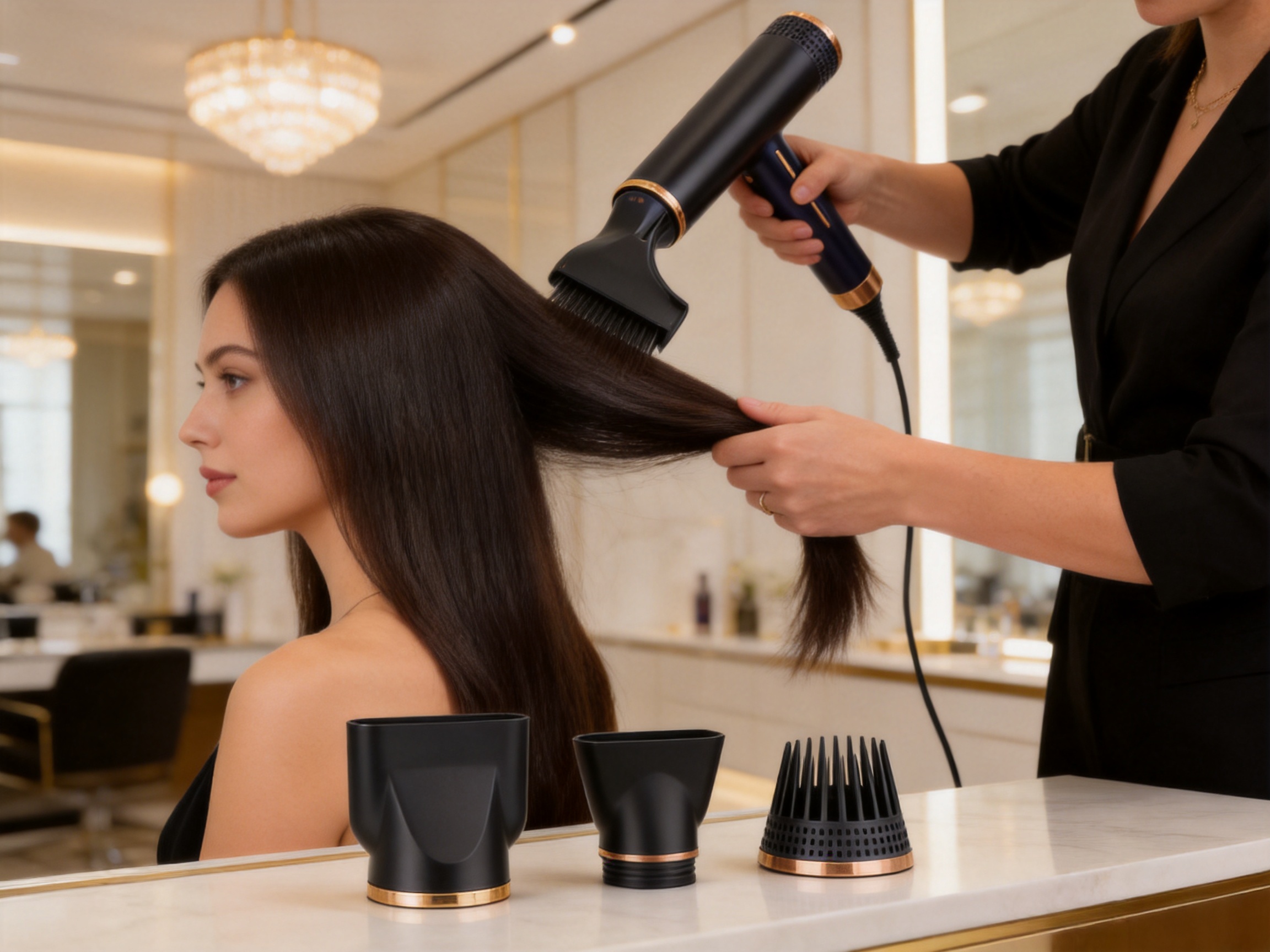
The JYS-D20 is supplied with a three-piece nozzle selection designed to support different drying and styling tasks. The available accessories include a large concentrator, a small concentrator, and an anti-flyaway nozzle. Each attachment directs the airflow differently, allowing the same dryer body to perform multiple functions.
| Accessory | Primary Function | Typical Use |
|---|
| Large concentrator | Broad, focused airflow | Fast drying and general smoothing on larger sections |
| Small concentrator | Narrow, targeted airflow | Detailed styling, roots, bangs, and smaller sections |
| Anti-flyaway nozzle | Smoothing and finishing airflow | Reducing visible flyaways and creating a polished finish |
The large concentrator is specified at a maximum size of approximately 96 × 46 millimeters. Its broader opening is suited to users who want focused airflow while working across larger portions of the hair. It can help direct air along the hair shaft, supporting a smoother appearance during brush-assisted drying.
The small concentrator is specified at approximately 73.5 × 46 millimeters. Its narrower airflow pattern offers greater precision. It can be useful for shaping bangs, controlling the roots, smoothing individual sections, or directing air through a round brush during professional styling.
The anti-flyaway nozzle is designed for finishing work. After the main drying and shaping process, short strands may remain lifted or separated from the overall hairstyle. The specialized airflow from this nozzle is intended to help smooth those visible flyaways and create a cleaner, more polished appearance.
This accessory approach offers a competitive advantage over products that include only one generic nozzle. The JYS-D20 can move from rapid drying to precision styling and final smoothing without requiring a separate appliance. For salon operators, this versatility can reduce the need to switch between tools. For home users, it creates a more complete styling system in one package.
6. Anti-Flyaway Styling and Hair-Finish Performance
Flyaways are often most noticeable after hair has already been dried. They may result from static, humidity, friction, hair texture, uneven moisture removal, or short new growth. A conventional concentrator can direct air effectively but may not be optimized for the final smoothing stage. The JYS-D20’s anti-flyaway nozzle is intended to address this final stage directly.
The nozzle uses controlled airflow to help guide loose strands toward a smoother overall direction. When used with an appropriate temperature and speed setting, it can support a polished appearance without requiring the user to apply the maximum heat level. This makes the accessory especially relevant to users who value a sleek finish after the main drying process.
The anti-flyaway function also strengthens the dryer’s appeal in professional environments. Salons often need to complete a hairstyle with attention to small details. A dedicated finishing attachment can help stylists refine the result and provide a more complete service. It is also useful for photography, formal events, hospitality grooming, and premium personal-care routines where the final appearance matters.
Results will naturally vary according to hair type, styling technique, humidity, product use, and the condition of the hair. The nozzle is not a substitute for professional hair-care practices, but it adds a targeted tool for improving the visual finish. Its inclusion demonstrates that the JYS-D20 has been designed for the entire drying process rather than only the initial removal of moisture.
7. Lightweight Ergonomics for Daily and Professional Use
Weight is a major factor in hair-dryer comfort. Users typically hold a dryer above shoulder level, often while simultaneously handling a brush or separating sections of hair. A heavy appliance can quickly create wrist, elbow, and shoulder fatigue. This concern is amplified in salons, where stylists may repeat the same movement throughout the day.
The brushless JYS-D20 weighs approximately 310 grams, while the brush-motor version weighs approximately 295 grams. This compact weight profile supports the model’s professional and travel-oriented positioning. The product body measures approximately 20.2 × 16.94 × 4.7 centimeters, creating a relatively compact format for a high-power dryer.
The lightweight construction does not mean the product is limited to low-power use. The brushless version combines its compact body with AC 120V/1,500W or AC 220V–240V/1,800W configurations, depending on the target market. This combination of power and low weight is one of the product’s strongest differentiators.
For professional stylists, reduced weight may support more comfortable operation during long appointments. For home users, it can make overhead drying less tiring. For hotels, resorts, and premium hospitality programs, a compact appliance can also be easier to store and handle.
Ergonomics are influenced by more than weight alone. Balance, handle shape, button placement, nozzle attachment, and cord design also affect the user experience. The JYS-D20’s control arrangement and compact form are intended to support a practical operating posture. The locking function can further reduce the need to adjust controls during use.
8. Electrical Flexibility for International Markets
International hair-appliance programs must account for different voltage and frequency standards. A product designed for one market cannot automatically be used in another market without confirming electrical compatibility. The JYS-D20 is available in regional configurations intended for AC 120V and AC 220V–240V applications.
The brushless model is specified for AC 120V, 60Hz at 1,500 watts, and AC 220V–240V, 50–60Hz at 1,800 watts. These configurations allow the product to be positioned in different regions while maintaining its core design and feature set. Brands and distributors should confirm the appropriate model, plug, labeling, certification, and packaging requirements for each destination market.
The availability of multiple configurations is particularly useful for OEM and ODM projects. A buyer may require different voltage versions for North America, Europe, Asia, the Middle East, or other markets. Working with a manufacturer that already develops appliances for multiple electrical standards can simplify product planning and reduce unnecessary redesign work.
Electrical flexibility also supports international retail strategies. A brand can create a coordinated product family with region-specific configurations while preserving the same product identity, accessories, and core user experience. This is valuable for companies selling through multiple channels, including professional distribution, e-commerce, hospitality supply, and specialty retail.
9. The Role of PCBA Integration
The internal PCBA is an important part of the JYS-D20’s intelligent architecture. Printed circuit boards allow the product to coordinate the motor, heating system, user controls, and safety-related operating logic within a compact structure. In a high-speed appliance, this type of integration is essential to achieving consistent performance.
PCBA-based control helps manage power delivery to the motor and heating elements. It also supports the product’s three-speed and three-temperature system, dedicated cold-air button, lock mode, and self-cleaning cycle. By placing these functions under electronic control, the product can provide a more organized and responsive user interface than a basic mechanical-switch design.
Electronic management also creates a foundation for future product development. Depending on the requirements of a particular project, the manufacturer may be able to adapt control logic, indicator systems, operating sequences, or regional settings. Any such customization would need to be evaluated through engineering review, safety testing, and production validation.
For buyers, PCBA integration can be viewed as an indicator that the product is developed as a complete system rather than as a collection of unrelated parts. The motor, heating structure, buttons, airflow reversal function, and accessories must work together. This systems-based approach supports reliability, user convenience, and repeatable performance.
10. Manufacturing Strengths and Product Development Capability
The JYS-D20 is manufactured by SHAOXING BANGSHUO ELECTRICAL APPLIANCE CO., LTD., whose business includes professional hair-care appliances and smart products for healthy living. The company’s predecessor and current factory operations are associated with YUYAO JOYS ELECTRICAL APPLIANCE CO., LTD. and the newer Shaoxing manufacturing facility.
The company was founded in 2009 and has developed experience in designing and producing small electrical appliances. Its capabilities include the development of new products, OEM manufacturing, ODM cooperation, and support for international customers. This combination is important for buyers who want more than an off-the-shelf product.
OEM customers may use the JYS-D20 as a platform product and request branded packaging, labeling, color coordination, accessory presentation, and market-specific documentation. ODM customers may seek deeper cooperation involving product appearance, structure, feature configuration, packaging concepts, and other development elements. The manufacturer’s product-development experience can support these projects from concept through mass production.
The company operates with a professional team of more than 140 people and four production lines. Its stated monthly output is approximately 300,000 sets, with annual shipments exceeding three million units. This production scale is significant for distributors and international brands that require stable supply, repeat orders, and consistent delivery planning.
Production capacity is especially important for seasonal categories. Hair dryers may experience strong demand during holiday promotions, back-to-school periods, wedding seasons, or major e-commerce campaigns. A manufacturer with several production lines and established supply-chain coordination can be better positioned to support these demand fluctuations than a small workshop with limited throughput.
At the same time, volume alone does not determine product quality. Effective manufacturing depends on process control, incoming-material management, assembly discipline, electrical testing, inspection standards, and traceability. A suitable supplier should be evaluated through product samples, factory audits, quality agreements, inspection records, and market-specific certification documentation.
11. Certification, Compliance, and Responsible Production
The company states that its main products have obtained or complied with international certifications and requirements including TUV GS, CE, CB, ERP, REACH, PAHS, ROHS, and SCCP, depending on the relevant product and market. These standards and regulatory frameworks address different aspects of safety, electromagnetic or electrical compliance, energy efficiency, chemical restrictions, and market access.
Certification requirements vary by destination and product configuration. Buyers should confirm which certificates apply specifically to the JYS-D20 version they intend to purchase. Voltage, motor type, plug configuration, power rating, packaging, and destination market can all influence the testing and documentation needed before commercial launch.
The factory has also passed BSCI and BEPI audits, according to the supplied company information. These audits relate to areas such as social responsibility, workplace conditions, environmental management, and responsible business practices. For international brands, this type of audit history can contribute to supplier qualification and responsible sourcing programs.
Compliance should be treated as an ongoing production responsibility rather than a one-time marketing statement. Component substitutions, factory changes, circuit revisions, and regional modifications may require additional evaluation. Strong communication between the manufacturer, buyer, testing laboratory, and regulatory team is therefore essential.
For the JYS-D20, important technical documentation may include electrical specifications, motor information, safety instructions, user manuals, test reports, material declarations, packaging details, and market-specific labeling. A professional manufacturer can help coordinate these documents as part of an OEM or ODM project.
12. Quality Control Considerations for a High-Speed Hair Dryer
A high-speed hair dryer contains several systems that must operate together safely and consistently. Quality control should cover the motor, heating elements, PCBA, control buttons, filter structure, housing, nozzles, power cord, plug, and packaging. Each area can affect the user’s experience and the product’s commercial performance.
Motor testing can include operation at different speed settings, startup behavior, abnormal noise inspection, airflow consistency, and endurance evaluation. The heating system should be checked for temperature stability, response to controls, cold-air operation, and protection against abnormal conditions. The self-cleaning cycle should also be validated to ensure that airflow reversal functions correctly.
Mechanical inspection is equally important. The detachable rear filter cover should fit securely while remaining easy to remove when maintenance is required. Nozzles should attach correctly and remain stable during normal use. The housing should be checked for surface quality, dimensional accuracy, assembly gaps, and resistance to ordinary handling.
Electronic controls require functional testing. Each speed, temperature, cold-air button, and lock mode should respond as intended. The PCBA should be evaluated for stable performance across the specified voltage and frequency range. For international orders, the correct plug, label, manual, and power rating must be matched to the destination market.
Packaging inspection helps prevent damage during transportation. The lightweight body and nozzle set should be protected against impact, pressure, moisture, and movement inside the carton. For branded retail projects, packaging also needs to present the product clearly and communicate the correct technical information without making unsupported claims.
13. Advantages for Professional Salons
Professional salons require tools that can support speed, precision, comfort, and repeatability. The JYS-D20 is suited to these needs through its high-speed motor, lightweight body, multiple controls, and three-nozzle kit.
Fast airflow can help shorten the rough-drying stage, allowing stylists to move more quickly to shaping and finishing. The large concentrator can cover broader sections, while the small concentrator can support detailed work around the roots, fringe, and individual sections. The anti-flyaway nozzle provides a dedicated option for final polishing.
The lightweight brushless version may reduce physical fatigue during repeated use. The three-speed and three-temperature system supports different hair textures and styling methods, while the cold-air button provides convenient finishing control. The lock mode can help maintain the selected setting when the stylist is focused on brushing and shaping.
Maintenance is also important in a salon. The self-cleaning function and detachable rear filter cover can help staff keep the appliance in better operating condition. Salons should still establish a regular cleaning and inspection schedule, especially in busy environments where hair and styling-product residue may accumulate quickly.
For salon chains and professional distributors, the product can serve as a premium tool with a clear feature story. Its high-speed BLDC motor, intelligent self-cleaning, lightweight construction, and anti-flyaway accessory provide multiple points of differentiation from basic professional dryers.
14. Advantages for Premium Home Users
Home users increasingly expect salon-inspired results without requiring a large collection of separate appliances. The JYS-D20 provides a versatile platform for everyday drying, controlled shaping, and final smoothing.
Users with long or thick hair may appreciate the high airflow and reduced drying time. Users with fine or fragile hair can select lower heat and airflow combinations. The dedicated cold-air button offers a simple way to finish a style, while the anti-flyaway nozzle can be used when a smoother appearance is desired.
The lightweight construction makes the appliance practical for regular use. Its compact dimensions also make storage easier than with some larger professional dryers. The self-cleaning function reduces the maintenance burden, and the detachable filter cover provides direct access when manual cleaning is needed.
Premium consumers often compare products based not only on power but also on design intelligence. The JYS-D20’s lock mode, PCBA control, high-speed motor, and specialized attachments create a more complete user experience than a basic dryer with a single switch and one concentrator.
15. Applications in Hospitality and Travel
The JYS-D20 is also suitable for selected luxury hospitality and travel-related applications. Hotels, resorts, serviced apartments, cruise operators, and premium guest facilities often seek hair-care appliances that combine strong performance with a modern appearance and manageable weight.
A lightweight dryer is easier for guests to handle, especially when it is stored in a bathroom or compact vanity area. A high-speed motor can help guests dry their hair quickly before work, meetings, travel, or evening events. The three-nozzle system may be offered as a premium amenity or reserved for upgraded rooms and suites.
Hospitality buyers should carefully evaluate electrical compatibility, cleaning procedures, replacement-part availability, packaging, and user instructions. They may also require customized color, logo application, wall-mounting solutions, cord specifications, or tamper-resistant designs. These requirements can be discussed during an OEM or ODM development process.
The product’s self-cleaning concept may be attractive in hospitality environments because it supports routine maintenance between guest stays. However, hotel maintenance teams should still inspect filters, cords, plugs, switches, and housings regularly to ensure safe continued use.
16. E-Commerce and Private-Label Potential
The JYS-D20 has a strong feature profile for premium e-commerce. Its product story can be communicated through several clear benefits: ultra-high-speed airflow, self-cleaning, anti-flyaway finishing, lightweight design, multiple settings, cold-air control, and professional nozzles.
For online retail, product communication should remain precise and evidence-based. Sellers should clearly identify the motor version, voltage, frequency, power, included attachments, weight, dimensions, and applicable market. Claims such as “quiet,” “fast,” or “salon-quality” should be supported by accurate product descriptions and should not imply performance beyond the validated specification.
High-quality product photography and demonstration content can show the detachable filter cover, accessory attachments, button layout, compact form, and different use scenarios. Instructional content can explain the self-cleaning cycle and proper maintenance. These details help customers understand why the product differs from a conventional dryer.
Private-label buyers may request customized packaging, colorways, user manuals, logo placement, retail inserts, warranty cards, and accessory arrangements. The manufacturer’s OEM and ODM capabilities can help brands create a distinctive market presentation while using an established technical platform.
17. Comparison with Conventional Hair Dryers
The JYS-D20 should not be evaluated only by its wattage. Its competitive position comes from the combination of motor technology, controls, maintenance design, accessories, and ergonomics.
| Evaluation Area | Conventional Basic Dryer | JYS-D20 High-Speed Dryer |
|---|
| Motor design | Often conventional brushed motor | BLDC motor option at approximately 110,000 RPM |
| Airflow control | Limited speed selection | Three wind speeds in the brushless version |
| Temperature control | Basic heat settings | Three temperature modes plus dedicated cold air |
| Maintenance | Manual filter cleaning only | Automatic reverse-air cleaning plus detachable rear filter cover |
| Styling accessories | Often one concentrator | Large concentrator, small concentrator, and anti-flyaway nozzle |
| Control stability | Limited locking or setting protection | Dedicated lock mode button |
| Portability | May be bulky or heavy | Approximately 310g in the brushless version |
| Market flexibility | May be limited to one voltage configuration | AC 120V and AC 220V–240V versions available |
This comparison does not mean that every conventional dryer has the same limitations. The market includes many well-engineered products at different price points. However, the JYS-D20 distinguishes itself by integrating features that are often separated across different product categories.
18. Recommended User Workflow
For efficient drying, users can begin by gently towel-drying the hair to remove excess water. The hair should not be dripping wet when the dryer is first applied. A suitable speed and temperature can then be selected based on hair type, moisture level, and styling objective.
During the rough-drying stage, the user may choose the large concentrator or use the dryer without a nozzle, depending on the desired airflow pattern. Hair can be divided into sections for more even drying. Users should keep the dryer moving and avoid holding heated airflow continuously on one small area.
For brush-assisted styling, the small concentrator can help direct air more precisely. The airflow should generally follow the direction of the hair cuticle when a smooth finish is desired. Different sections can be shaped with a round brush, paddle brush, or other suitable styling tool.
At the finishing stage, users can select the cold-air button to cool the style. The anti-flyaway nozzle can then be used to guide short strands and improve the overall appearance. The lock function may be activated when the preferred setting has been selected and the user wants to prevent accidental changes.
After use, the dryer should be switched off and allowed to cool before storage or filter maintenance. The rear filter area should be checked periodically, and the self-cleaning function should be used according to the operating instructions.
19. Buyer and Distributor Considerations
Commercial buyers should first determine the target market and select the correct motor and voltage configuration. The brushless edition is the premium configuration with three speeds, three temperatures, dedicated cold air, and lock mode. The brush-motor version may be suitable for buyers seeking a different cost structure or a simpler control arrangement.
Buyers should also confirm the accessory package. The standard product information identifies three accessory options, but exact inclusion may depend on the order configuration. Packaging, manuals, plug types, colors, and branding should be confirmed before production.
Sample approval is recommended before mass production. The sample review should cover airflow, temperature behavior, control operation, motor sound, self-cleaning performance, nozzle attachment, filter-cover fit, weight, appearance, and packaging. Buyers may also conduct independent laboratory testing or third-party inspection for the destination market.
For long-term supply, buyers should discuss spare parts and after-sales support. Potential replacement items may include rear filter covers, nets, nozzles, power cords, switches, and other approved components. Clear communication about warranty terms, repair procedures, minimum order quantities, lead times, and quality claims can help establish a stable business relationship.
20. Company Manufacturing and Supply Capability
SHAOXING BANGSHUO ELECTRICAL APPLIANCE CO., LTD. combines product-development experience with manufacturing capacity in Zhejiang Province, China. The company specializes in hair dryers, hair curlers, hair straighteners, ionic brushes, and other small electrical appliances, as well as selected smart products for healthy living.
Its factory structure supports both established product manufacturing and customized projects. A professional team of more than 140 people and four production lines provide a foundation for volume orders. The stated monthly output of approximately 300,000 sets and annual shipments exceeding three million units indicate experience in handling large-scale production requirements.
The company exports to more than 30 countries and regions and has worked with internationally recognized customers and brands, including ALDI, ELLE, COSMOPOLITAN, and TRISTAR, according to the supplied company information. Such cooperation suggests familiarity with international product expectations, documentation, packaging, delivery schedules, and customer-service requirements.
For brands looking to expand a hair-care portfolio, the manufacturer can provide a starting point for coordinated product development. A customer may source a high-speed dryer such as the JYS-D20 alongside curlers, straighteners, hot-air brushes, ionic brushes, or other personal-care appliances. This can simplify supplier management and create a consistent product family.
21. Sustainability and Product Life-Cycle Perspective
A durable small appliance can provide value beyond its initial purchase by remaining useful over an extended period. The JYS-D20’s self-cleaning system and detachable rear filter cover support this life-cycle perspective by making routine maintenance more accessible. Keeping the airflow path clear may help the appliance operate more effectively and reduce avoidable performance decline.
Energy use is influenced by power rating, operating time, temperature selection, and user habits. A high-power appliance should be used responsibly, with appropriate settings selected for the task. Fast drying may help reduce total operating time, although actual energy consumption depends on the individual user and routine.
Responsible product development also includes compliance with material restrictions and environmental requirements. The company’s stated experience with REACH, ROHS, ERP, PAHS, and SCCP-related requirements can support international sourcing programs, subject to product-specific verification and current regulatory review.
Buyers should consider packaging reduction, recyclable materials, product repairability, spare-part availability, and end-of-life instructions when developing a responsible product program. These issues can be addressed during ODM planning and packaging development.
22. Frequently Asked Questions
Q1: What makes the JYS-D20 different from a standard hair dryer?
The JYS-D20 combines a high-speed BLDC motor, intelligent self-cleaning, three airflow speeds, three temperature modes, a dedicated cold-air button, lock mode, a detachable rear filter cover, and three specialized nozzles. This combination provides a broader feature set than many basic dryers.
Q2: How fast is the brushless motor?
The brushless version operates at approximately 110,000 revolutions per minute. The final airflow experience also depends on the electrical configuration, internal airflow design, nozzle, and selected operating mode.
Q3: How does the self-cleaning function work?
The dryer automatically reverses the motor airflow during the self-cleaning process. This reverse airflow helps remove dust and debris from the internal airflow area. The rear filter cover can also be detached for manual cleaning.
Q4: Does self-cleaning mean that manual maintenance is unnecessary?
No. Self-cleaning is designed to support maintenance, not replace it. Users should periodically inspect and clean the detachable rear filter cover and net according to the product instructions.
Q5: What is the purpose of the lock button?
The lock function helps prevent accidental changes to the selected operating settings during styling. It can be useful when the dryer is held at an angle or when the user is concentrating on brushing and shaping.
Q6: What is the anti-flyaway nozzle used for?
The anti-flyaway nozzle is designed for finishing work. It directs controlled airflow to help smooth visible flyaways and short loose strands after the main drying and styling process.
Q7: What nozzles are available?
The accessory selection includes a large concentrator, a small concentrator, and an anti-flyaway nozzle. The large concentrator is intended for broader focused airflow, while the small concentrator supports more detailed styling.
Q8: Is the JYS-D20 suitable for professional salons?
Yes. Its high-speed motor, lightweight brushless version, multiple settings, cold-air control, lock function, self-cleaning system, and professional nozzle selection make it suitable for salon environments. Salons should select the correct voltage configuration and establish routine maintenance procedures.
Q9: Is the dryer suitable for home users?
Yes. The product is designed for premium home use as well as professional applications. Its lightweight design, fast airflow, flexible settings, and anti-flyaway accessory support everyday drying and styling.
Q10: What voltage versions are available?
The brushless model is specified for AC 120V, 60Hz at 1,500 watts and AC 220V–240V, 50–60Hz at 1,800 watts. Buyers should confirm the correct model and plug configuration for the intended market.
Q11: How much does the dryer weigh?
The brushless version weighs approximately 310 grams, while the brush-motor version weighs approximately 295 grams. Final packaged weight will be higher and depends on accessories and packaging materials.
Q12: Can the product be customized for private-label sales?
The manufacturer provides OEM and ODM services. Possible project elements may include branding, packaging, colors, manuals, accessory presentation, labeling, and market-specific configurations, subject to engineering review and minimum order requirements.
Q13: Does the company support large-volume orders?
The company operates four production lines, has a professional team of more than 140 people, and reports monthly output of approximately 300,000 sets. Buyers should confirm current capacity, lead time, order quantity, and production scheduling for each project.
Q14: What certifications are associated with the manufacturer’s products?
The company states that its main products have obtained or complied with certifications and requirements including TUV GS, CE, CB, ERP, REACH, PAHS, ROHS, and SCCP, depending on the product and market. Product-specific documentation should be confirmed before purchase.
Q15: How can buyers begin a project?
Buyers can begin by confirming the target market, motor type, voltage, power rating, accessory package, branding requirements, packaging, order quantity, and certification needs. Sample evaluation and technical-document review should be completed before mass production.
Conclusion
The JYS-D20 Self-Cleaning Anti-Flyaway High-Speed Hair Dryer represents a comprehensive approach to modern hair-care appliance design. Its approximately 110,000-RPM BLDC motor provides the foundation for high-velocity airflow, while the compact and lightweight body supports comfortable operation. Intelligent self-cleaning, a detachable rear filter cover, PCBA-based control, three speeds, three temperatures, cold-air operation, and lock mode create a more complete user experience than many conventional dryers.
The three-piece nozzle system further expands the product’s versatility. The large concentrator supports broader drying, the small concentrator enables precision styling, and the anti-flyaway nozzle helps refine the final appearance. These features make the dryer relevant to salons, premium home users, luxury hospitality programs, and private-label e-commerce brands.
Its commercial value is strengthened by the manufacturer’s OEM and ODM capabilities, production capacity, international market experience, factory audit history, and broad certification background. For buyers seeking a modern hair dryer with a strong feature profile and flexible manufacturing support, the JYS-D20 offers a practical platform for professional and premium consumer applications.
References
1. Product specification and feature information for the JYS-D20 Self-Cleaning Anti-Flyaway High-Speed Hair Dryer, supplied by the manufacturer.
2. Technical information regarding BLDC motor operation, electronic commutation, and high-speed motor applications in small electrical appliances.
3. General principles of hair-dryer airflow control, heating management, cold-air styling, and concentrator-nozzle design.
4. Manufacturer-provided information concerning OEM and ODM services, production lines, output capacity, export markets, and factory operations.
5. Manufacturer-provided information concerning TUV GS, CE, CB, ERP, REACH, PAHS, ROHS, and SCCP-related product requirements.
6. Manufacturer-provided information concerning BSCI and BEPI factory audit history and responsible manufacturing practices.
7. General guidance for maintenance of hair dryers, including filter inspection, dust removal, electrical safety, and routine appliance care.
8. Product-development principles for international small electrical appliances, including voltage configuration, labeling, packaging, testing, and market compliance.


 English
 Español