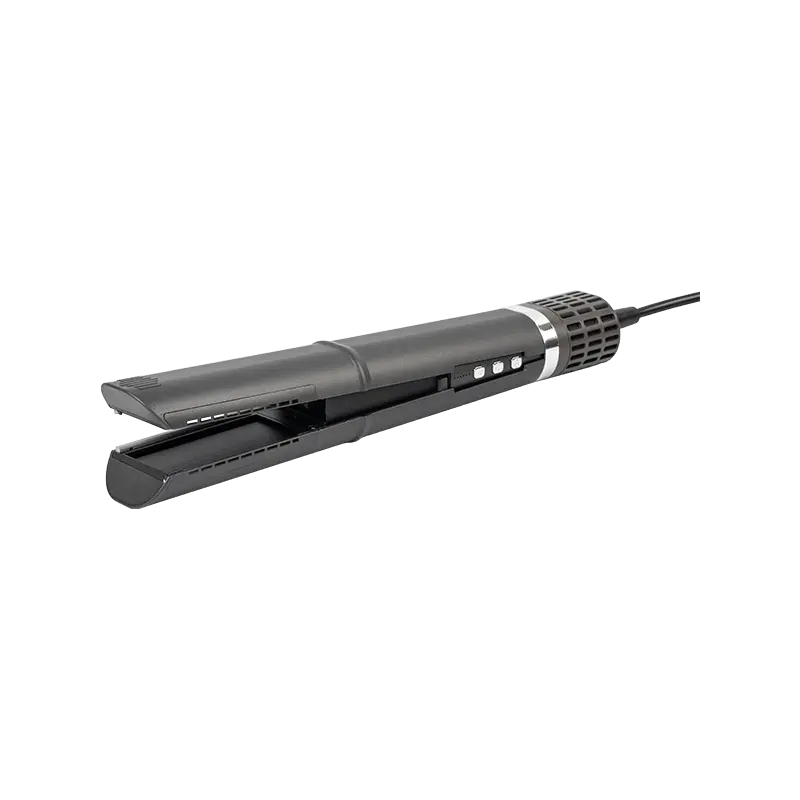
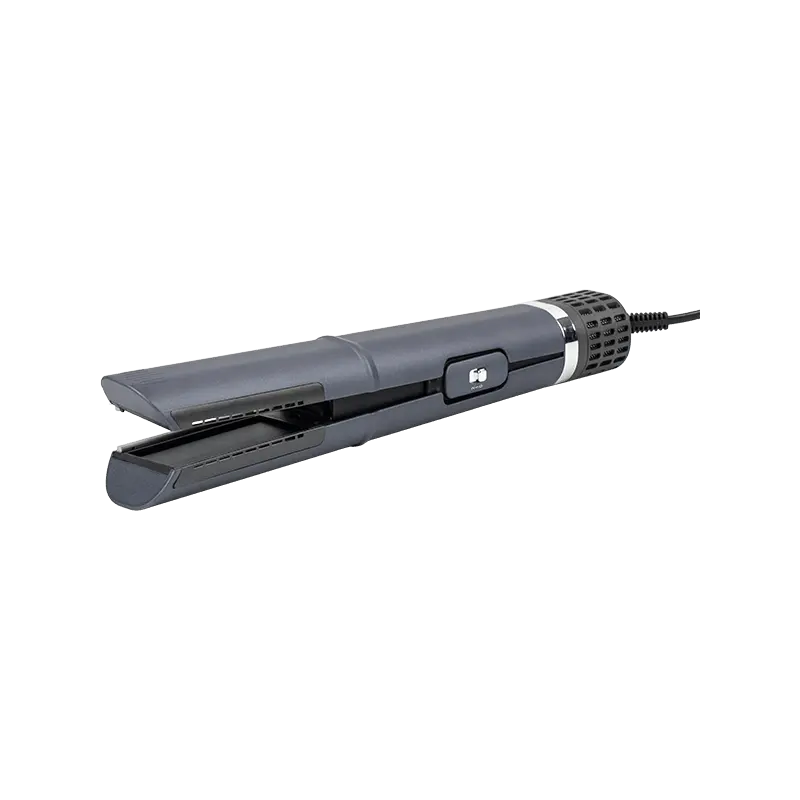
Modern hair styling is no longer defined only by high heat and fast results. Consumers increasingly want a styling tool that can straighten hair efficiently while helping preserve softness, shine, and manageability. Dryness, frizz, static, rough texture, and repeated heat exposure are common concerns for people who straighten their hair regularly. These concerns have created strong demand for advanced hair straighteners that combine controlled temperature, ergonomic operation, protective features, and moisture-supporting technology.
The JYS-C3 Ultrasonic Steam Mist Hydrating Hair Straightener is designed to meet these expectations. It combines a conventional heated straightening system with ultrasonic atomization technology, a removable water tank, a guided upper-and-lower comb structure, five temperature settings, dual-voltage compatibility, and multiple safety and convenience features. Rather than relying exclusively on dry heat, the device introduces an ultra-fine steam mist during styling to support a smoother and more hydrated finish.
This article examines the product’s design, technical performance, user benefits, commercial potential, and manufacturing strengths. It also explains why this type of straightener is attractive for home users, salons, distributors, retailers, private-label brands, and international buyers seeking a reliable OEM or ODM hair-care appliance.
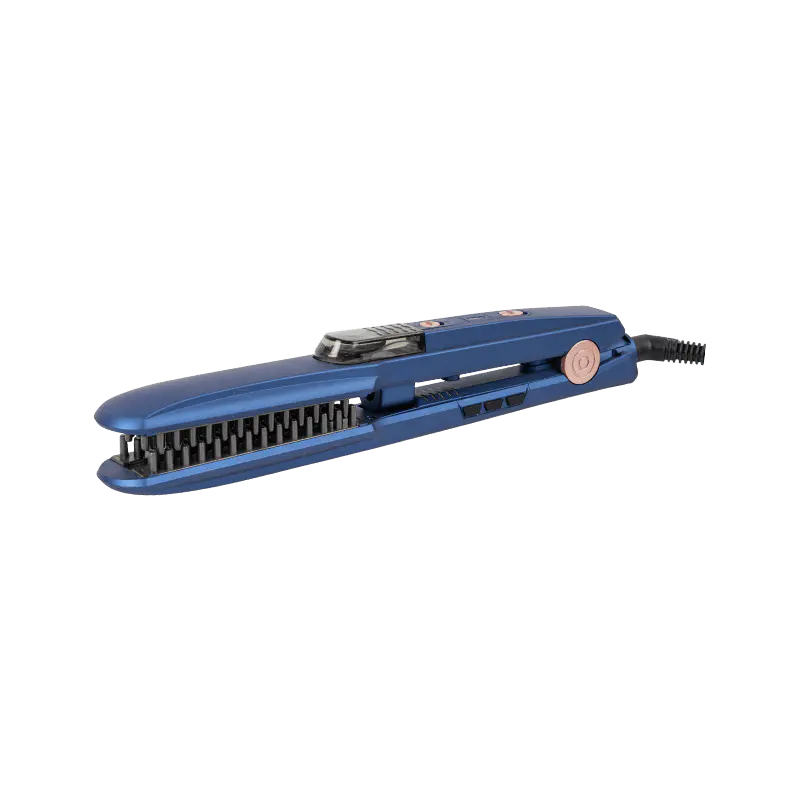
JYS-C3 Ultrasonic Steam Mist Hydrating Hair Straightener
1. The Changing Requirements of Modern Hair Straighteners
Traditional hair straighteners use heated plates to reshape the hair shaft. When the plates pass over a section of hair, heat and pressure temporarily alter the hair’s appearance, helping it look straighter and more polished. Although this method is familiar and effective, excessive heat or incorrect temperature selection can leave hair feeling dry, brittle, or dull.
Many users also experience uneven styling. A conventional flat iron may miss strands, require several passes, or create inconsistent results when the hair is thick, wavy, curly, layered, or difficult to control. Repeated passes increase styling time and may expose hair to more heat than necessary.
Another challenge is that the needs of consumers vary significantly. Fine hair generally requires lower temperatures, while coarse or highly textured hair may require greater heat and more controlled tension. A single fixed temperature cannot provide an ideal experience for every user. A modern straightener therefore needs flexible temperature adjustment, effective hair guidance, rapid handling, and a design that supports different hair types.
The JYS-C3 responds to these challenges through a combination of five adjustable temperature settings, upper and lower guiding teeth, ultrasonic steam mist, and a removable water tank. Each feature addresses a different part of the styling process. Temperature control helps users match heat to their hair type. The comb design helps organize strands. Steam mist adds moisture during styling. The detachable water tank simplifies refilling and cleaning.
2. How Ultrasonic Atomization Supports Hydrated Styling
The defining feature of the JYS-C3 is its ultrasonic atomization steam spray. The system converts water into an ultra-fine mist that is released during the straightening process. Unlike a simple spray mechanism that produces relatively large droplets, ultrasonic atomization is designed to create a finer mist for more even distribution.
When hair is exposed to high heat without adequate moisture management, the surface can feel rough and dehydrated. The ultra-fine mist in the JYS-C3 helps introduce moisture while the heated styling surfaces reshape the hair. This creates a more balanced styling experience: heat provides the straightening action, while the mist helps reduce the dry sensation often associated with conventional high-temperature styling.
The technology is particularly relevant for users with dry, damaged, chemically treated, or frizz-prone hair. Such users may want straight, polished results but hesitate to use traditional flat irons frequently. A steam-assisted tool can offer a more comfort-oriented alternative by helping hair feel smoother and more supple after styling.
Steam mist does not eliminate the need for responsible heat use. Users should still select an appropriate temperature, avoid holding the tool in one place for too long, and follow normal hair-care practices. However, the addition of atomized moisture provides a meaningful functional difference compared with a basic dry straightener.
The mist can also help improve the visual finish of the hairstyle. Hair that is properly guided and evenly styled may appear more reflective and polished. By helping reduce surface roughness and frizz, the JYS-C3 is positioned not only as a straightening device but also as a tool for achieving a smoother overall appearance.
Ultrasonic Atomization Versus Basic Steam Systems
Not all steam straighteners provide the same user experience. A basic steam tool may release visible moisture in larger amounts, potentially creating uneven wet spots or requiring more frequent water management. Ultrasonic atomization is intended to produce a fine mist that can be distributed more evenly through the hair.
This fine mist is useful because hair should not become excessively wet during styling. The purpose is to support hydration while preserving the efficiency of the heated straightening process. A controlled mist can be more practical for everyday styling than a heavy steam output that slows down the process or leaves hair damp.
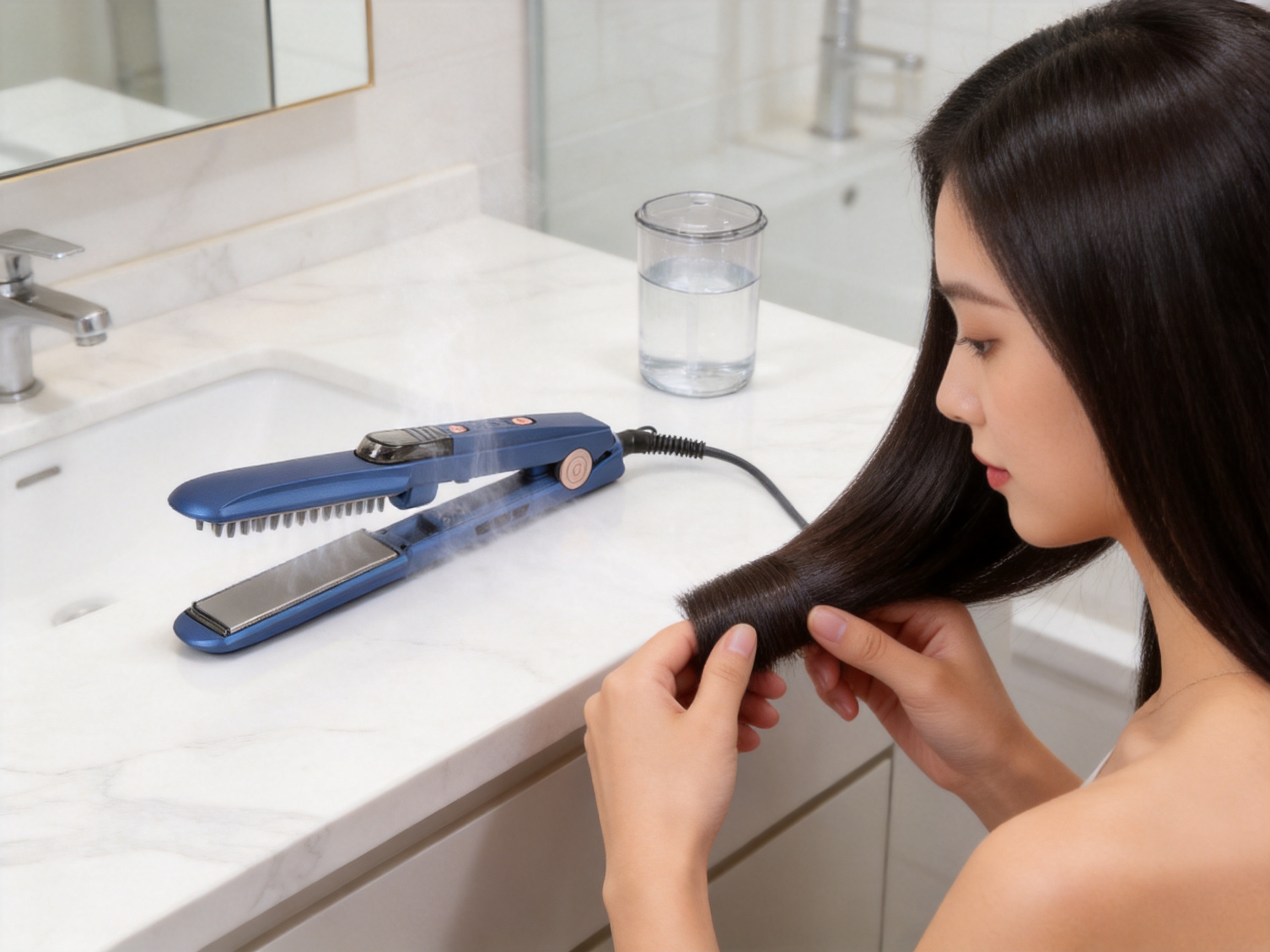
The JYS-C3 also includes a dedicated ultrasonic atomization switch with an indicator light. This gives users direct control over whether the mist function is active. The tool can therefore be used in two modes: as a steam-assisted straightener for moisture-focused styling or as a conventional heated straightener when users prefer to work without mist.
3. Five Temperature Settings for Different Hair Types
Temperature flexibility is one of the most important factors in a hair straightener. Hair varies in thickness, density, porosity, texture, and chemical condition. A temperature that works well for thick, coarse hair may be unnecessarily high for fine or fragile hair. The JYS-C3 provides five adjustable temperature settings within a range of 150°C to 230°C.
The lower part of the range is suitable for users who want a gentler styling experience. Fine, delicate, bleached, or chemically treated hair often benefits from a lower heat setting and fewer passes. Medium settings can be used for normal or moderately wavy hair, while higher settings are available for thicker, coarser, or more resistant hair.
A five-level system offers a practical balance between simplicity and control. Too few settings limit customization, while an overly complicated control panel may confuse everyday users. Five temperature levels allow the product to serve a wide market without making operation unnecessarily difficult.
Temperature adjustability also benefits professional environments. In a salon, stylists work with clients who have different hair conditions and styling requirements. A flexible tool can be incorporated into a broader service menu, including smoothing, straightening, preparation for updos, and finishing work.
Users should select the lowest temperature that produces the desired result. Hair should be dry or appropriately prepared according to the stylist’s instructions, and a heat-protective product may be used where suitable. The steam function is intended to support hydration, but it should not be considered a substitute for correct operating technique.
Hair condition or type |
Suggested approach |
Potential benefit of the JYS-C3 |
Fine or fragile hair |
Begin with a lower temperature and use controlled passes |
Reduced need for excessive heat and adjustable styling intensity |
Normal or slightly wavy hair |
Use a middle temperature according to texture and desired finish |
Balanced performance for everyday straightening |
Thick or coarse hair |
Use a higher setting when necessary and divide hair into sections |
Guiding teeth help organize and control dense sections |
Dry or chemically treated hair |
Use a moderate temperature and avoid repeated passes |
Ultrasonic mist supports a less dry styling experience |
Curly or frizz-prone hair |
Work in manageable sections with consistent movement |
Moisture support and guided hair movement help create a smoother finish |
4. Upper and Lower Teeth for More Consistent Hair Guidance
A straightener’s heating surfaces are only effective when hair moves through them in a controlled way. Loose strands may escape, overlap, or become unevenly distributed. This is especially common when styling thick hair or attempting to straighten hair quickly.
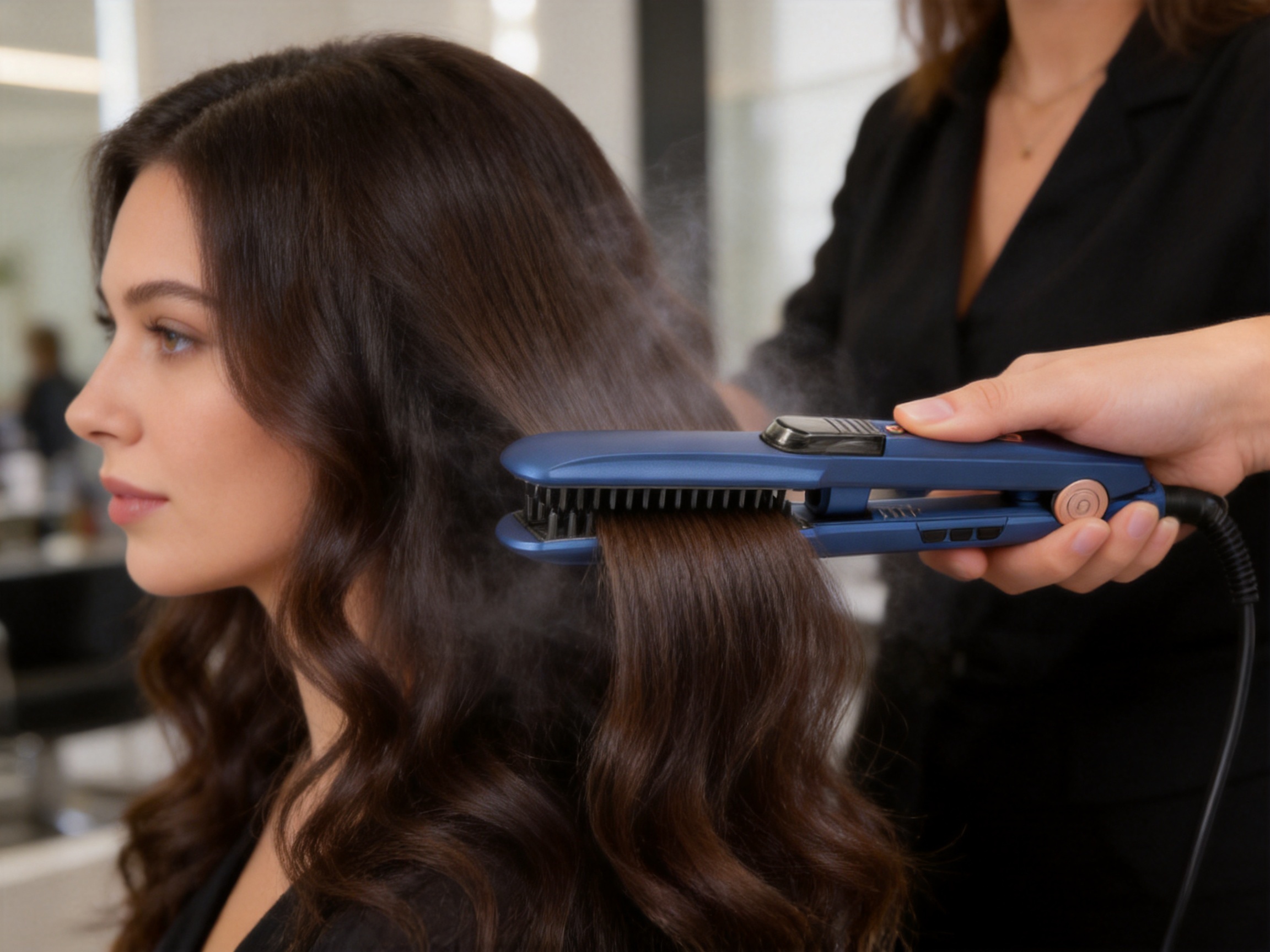
The JYS-C3 uses an upper-and-lower teeth comb design to guide the hair through the styling area. The teeth help separate and organize strands before they pass through the heated sections. This design is intended to reduce the chance of missing individual hairs and can contribute to a more uniform finish.
Hair guidance is also important for reducing unnecessary repetition. If a section is properly aligned on the first pass, the user may not need to go over it repeatedly. Fewer passes can help save time and reduce cumulative heat exposure.
The comb structure may be especially useful for users with dense, wavy, or frizz-prone hair. Instead of attempting to flatten a large, loosely gathered section, the teeth help bring strands into a more orderly path. This allows the heated elements and steam mist to interact with the hair more consistently.
For best results, users should still divide very thick hair into sections. The guiding teeth improve control, but no straightener can replace appropriate sectioning when hair density is high. Combining the comb design with careful sectioning can improve both speed and styling consistency.
Why Hair Guidance Matters for Retail Buyers
For retailers and private-label brands, visible functional features can make a product easier to explain to consumers. A comb-assisted straightener offers a clear point of differentiation from a basic flat iron. Customers can immediately understand that the teeth are intended to guide and capture more strands during styling.
This feature also broadens the product’s appeal. A tool that combines heated plates with a comb structure can attract consumers who find standard flat irons difficult to use. It may be positioned as an approachable product for home users while still offering features relevant to professional styling.
5. Removable Water Tank and Practical Daily Operation
The removable water tank is another important part of the JYS-C3 design. A detachable tank makes it easier to fill the device before use and allows users to clean the tank separately. This is preferable to a permanently enclosed reservoir that may be difficult to refill or maintain.
Water management is essential for a steam styling product. Users need a straightforward way to add water, monitor usage, and keep the reservoir clean. The removable design supports more convenient maintenance and can help preserve consistent mist performance over time.
According to the provided product information, the water tank typically supports approximately two to three full styling sessions, depending on hair length and steam usage. Actual duration may vary according to the amount of hair being styled, the number of passes, and whether the atomization function is used continuously.
The water tank also gives the product a practical advantage in retail positioning. Customers are often concerned that steam appliances will be difficult to maintain. A removable tank provides a simple explanation: fill, attach, use, remove, and clean as needed.
Users should follow the product’s operating instructions regarding water quality, filling level, storage, and cleaning. The tank should not be overfilled, and the device should be disconnected from power before water-related maintenance. Proper care helps protect the appliance and maintain reliable mist output.
6. Dual-Voltage Compatibility for International Use
The JYS-C3 supports dual voltage, with a rated input of 110V to 230V or 220V to 240V depending on market specification, at 50/60Hz. This makes the product suitable for international distribution and convenient for travelers who use the device in different regions.
Voltage compatibility is particularly valuable in the personal-care appliance category. Hair straighteners are commonly used during business trips, holidays, relocation, and international study. A dual-voltage model can reduce the need for a separate voltage converter when used in a compatible electrical environment.
Travel users should still verify the voltage requirements of their destination and use the correct plug adapter where necessary. A plug adapter changes the physical connection but does not necessarily convert voltage. Clear packaging instructions and market-specific labeling are therefore important parts of a responsible sales program.
For importers, dual-voltage design simplifies product planning. One model can potentially serve multiple regional markets, reducing the need to maintain separate inventory for different input voltages. This can support more efficient distribution, especially for e-commerce sellers and international private-label programs.
7. Safety and Convenience Features
A modern heated appliance must provide more than styling performance. Safety, storage, cord management, and operational feedback strongly influence the user experience. The JYS-C3 includes several features designed to make everyday handling more convenient.
Safety Cut-Off Protection
The built-in safety cut-off is intended to help prevent overheating. If the product remains unattended or reaches a potentially unsafe operating condition, automatic shutoff protection can reduce risk. This is particularly valuable in busy households where users may become distracted after styling.
Automatic shutoff should be viewed as a secondary safety measure rather than a replacement for switching off and unplugging the appliance after use. Users should always place the straightener on a heat-resistant surface and allow it to cool before storage.
Lock Catch Switch
The lock catch switch helps secure the device in a closed position when stored. This can reduce the space required in a drawer, suitcase, or salon workstation. It also helps protect the heated surfaces from contact with other objects after the appliance has cooled.
360-Degree Rotating Cord
The 360-degree rotating cord is designed to reduce twisting and tangling during operation. Cord rotation is especially useful when the user changes hand position, styles the back of the head, or works around another person in a salon setting.
A swivel cord can also make the appliance feel more flexible and professional. It reduces the need to reposition the entire product simply because the cable has become wrapped around the handle.
Ultrasonic Switch and Indicator Light
The separate atomization switch provides direct control over the steam mist function. The indicator light shows the operational status of the ultrasonic system, allowing users to recognize whether mist mode is active.
This separation between heat operation and mist operation increases flexibility. Some users may prefer steam-assisted styling for dry or frizzy hair, while others may choose conventional straightening for quick touch-ups or when the water tank is empty.
8. Ergonomic and Travel-Friendly Product Design
Hair straightening often requires repeated movement, wrist rotation, and careful positioning. A device that is difficult to handle can make styling tiring, especially when users work on long or dense hair. The JYS-C3 combines a compact giftbox size of approximately 35 by 11.2 by 5 centimeters with a locking structure and rotating cord, supporting convenient storage and transport.
The compact format is suitable for bathroom cabinets, dressing tables, salon drawers, and travel luggage. Dual-voltage capability further strengthens its travel appeal. For brands targeting frequent travelers, the product can be marketed as a versatile hair-care appliance for use at home and away.
Ergonomic performance depends on more than dimensions. The control layout, switch placement, cord movement, water tank access, and comb geometry all influence how intuitive the appliance feels. By combining these elements, the JYS-C3 is positioned as a practical tool rather than a basic heating device.
Product packaging also plays an important role. The giftbox format provides space for retail presentation, product information, electrical specifications, operating guidance, and safety instructions. For OEM and private-label buyers, packaging can be adapted to match brand identity, target market requirements, and language needs.
9. Comparison with Conventional Dry Hair Straighteners
The JYS-C3 should not be viewed merely as another heated straightener. Its primary distinction is the combination of dry heat styling with ultrasonic mist and hair-guiding teeth. These features address limitations found in many basic models.
Product characteristic |
Basic dry straightener |
JYS-C3 ultrasonic steam mist straightener |
Moisture support |
Usually none |
Ultra-fine mist generated by ultrasonic atomization |
Temperature flexibility |
May have limited settings |
Five settings from 150°C to 230°C |
Hair guidance |
Usually relies on flat plates alone |
Upper and lower teeth help guide strands |
Water management |
Not applicable |
Removable water tank |
Operating modes |
Heat-only operation |
Heat styling with optional atomization |
International use |
Depends on model |
Dual-voltage design |
Storage convenience |
Varies by model |
Lock catch switch and compact giftbox format |
Compared with a simple dry straightener, the JYS-C3 offers more functions and greater operating flexibility. Compared with some steam-based competitors, its removable water tank and independently controlled ultrasonic switch provide practical advantages. The comb-assisted design also gives it a recognizable feature that can help distinguish it in a crowded market.
Competitive positioning should always be based on verified market comparisons, but the product’s feature combination gives buyers several strong selling points: hydration-focused styling, adjustable heat, guided hair movement, global voltage compatibility, and safety-oriented construction.
10. Applications for Home Users
For home users, the JYS-C3 is designed to simplify the process of creating smooth, straight, and polished hairstyles. It can be used for everyday styling, special occasions, work preparation, travel, and touch-ups between salon visits.
Consumers with dry or frizzy hair may value the moisture-supporting function. Users with thick or wavy hair may appreciate the guiding teeth and adjustable heat. People who travel internationally may choose the product because of its dual-voltage capability and compact storage format.
The product can also appeal to households with multiple users. Because the temperature can be adjusted across five settings and the atomization function can be switched on or off, different family members can select a styling approach suited to their hair condition.
For best results, users should begin with clean, prepared hair, divide hair into manageable sections, choose an appropriate temperature, and move the straightener steadily from roots toward ends while avoiding prolonged contact with one area. When steam mode is used, the water tank should be filled correctly and maintained according to the instructions.
11. Applications for Professional Salons
Salons require tools that provide reliable performance, operational flexibility, and a differentiated experience for clients. The JYS-C3 can support straightening services, smoothing treatments, styling preparation, finishing work, and retail demonstrations.
The ultrasonic mist function gives stylists an additional way to address clients who are concerned about dryness or heat exposure. It can also help salons present a more advanced service concept based on moisture-supported styling rather than conventional dry heat alone.
The five temperature settings are useful when working with different hair textures and conditions. A stylist can use a more moderate temperature for delicate or treated hair and select a higher setting for dense or resistant hair when appropriate.
The removable tank supports frequent maintenance, while the 360-degree cord helps with continuous workstation movement. The lock catch and compact format make it easier to organize the tool when several appliances are used in the same salon.
Salons may also use the JYS-C3 as a retail recommendation. A client who enjoys the result of steam-assisted styling may be interested in purchasing a similar tool for home use. This creates a potential connection between professional services and product sales.
12. Manufacturing Strengths and Product Development Capability
The company behind the product has experience in small electrical appliances, professional hair-care products, and smart products for healthy living. The business history includes a former factory, YUYAO JOYS ELECTRICAL APPLIANCE CO., LTD., and a newer manufacturing operation, SHAOXING BANGSHUO ELECTRICAL APPLIANCE CO., LTD. The company was founded in 2009 and has developed capabilities in product creation, OEM production, and ODM development.
This background is relevant to the JYS-C3 because advanced hair appliances require coordination across industrial design, heating systems, electrical engineering, water management, plastics, assembly, testing, packaging, and compliance. Experience in these areas helps reduce the distance between a product concept and a stable commercial model.
The company operates with a professional team of more than 140 people and four production lines. Reported monthly output is approximately 300,000 sets, with annual shipments exceeding three million units. This scale can support both regular purchase orders and larger international programs, subject to product scheduling and capacity allocation.
Manufacturing scale also supports supply-chain coordination. Hair straighteners involve multiple components, including heating elements, control systems, switches, indicator lights, water tanks, cords, housings, comb structures, packaging, and printed materials. A coordinated factory environment can help manage these components more efficiently than a fragmented production arrangement.
From Concept to Commercial Product
ODM capability allows buyers to work with the manufacturer on product concepts, feature combinations, appearance, packaging, and market positioning. OEM capability allows a buyer to use an existing product platform under a private brand, subject to agreed specifications and customization requirements.
For the JYS-C3 platform, possible customization areas may include color, surface finish, logo placement, packaging design, user manuals, plug configuration, language labeling, and selected market requirements. Any customization must be reviewed for technical feasibility, minimum order quantities, tooling needs, certification requirements, and production schedules.
A capable manufacturer should also assist buyers in balancing feature ambition with commercial practicality. For example, a brand may want a sophisticated steam straightener at a specific retail price. The factory’s engineering and sourcing experience can help determine which features provide the greatest consumer value while maintaining reliability and manufacturability.

13. Quality, Certification, and Compliance Orientation
According to the provided company information, the manufacturer’s main products have obtained or worked with international certifications and compliance standards including TUV GS, CE, CB, ERP, REACH, PAHS, ROHS, and SCCP. The company has also successfully passed BSCI and BEPI audits.
These certifications and audits cover different aspects of product safety, market access, chemical restrictions, energy-related requirements, environmental responsibility, and social compliance. The precise requirements applicable to a particular JYS-C3 order depend on the destination market, voltage configuration, plug type, packaging, labeling, and buyer specifications.
For importers and brand owners, compliance support is a key part of supplier evaluation. A hair straightener contains heating and electrical systems that must be assessed carefully. Buyers should request current test reports, declarations, certification documents, factory audit records, and product-specific technical files before placing a commercial order.
Quality management should also include incoming component inspection, assembly checks, electrical safety testing, temperature verification, atomization testing, water tank inspection, cord and switch testing, appearance inspection, aging tests, and finished-product sampling. These processes help identify defects before products reach the customer.
Relevant Production Control Points
The heating system should be checked for stable operation and appropriate temperature response. The control system should be inspected to confirm that each setting corresponds to the intended range. The atomization system should be evaluated for mist consistency and switch function. The water tank should be checked for secure installation, removal, sealing, and resistance to leakage.
The lock catch should operate smoothly without excessive looseness. The rotating cord should withstand normal movement and repeated handling. The safety cut-off should be verified during appropriate testing procedures. Cosmetic inspection should confirm that the housing, comb teeth, switches, indicator light, and packaging meet approved samples.
Manufacturing processes may vary by order and market, but these checkpoints illustrate why hair appliances require more than simple final assembly. Reliable performance depends on coordination between design validation, component quality, production discipline, and final inspection.
14. Export Experience and International Market Suitability
The company’s products are exported to more than 30 countries and regions. It also maintains long-term cooperation with recognized customers including ALDI, ELLE, COSMOPOLITAN, and TRISTAR. This international experience indicates familiarity with retailer requirements, product documentation, packaging coordination, quality expectations, and cross-border delivery processes.
International export experience is valuable for buyers because different markets may require different electrical configurations, languages, markings, warranty procedures, carton specifications, and testing documentation. A supplier that understands these differences can help reduce communication problems during development and shipment preparation.
The JYS-C3’s dual-voltage design gives it broad potential for international positioning. However, each market still requires careful review of electrical standards, plug formats, labeling, user instructions, import rules, and applicable certifications. Buyers should work with the manufacturer to confirm the exact configuration before production.
15. Packaging, Logistics, and Bulk Purchasing Information
The stated giftbox size for the JYS-C3 is approximately 35 by 11.2 by 5 centimeters. The carton size is approximately 46 by 36 by 34.6 centimeters, with 27 pieces per carton. These specifications are important for warehouse planning, container loading, freight calculation, and retail display preparation.
Reported container quantities are approximately 13,176 pieces for a 20-foot general-purpose container, 27,324 pieces for a 40-foot general-purpose container, and 32,022 pieces for a 40-foot high-cube container. Actual loading quantities may vary depending on packaging adjustments, pallet use, shipping requirements, and final carton configuration.
Bulk buyers should confirm carton dimensions, gross and net weights, palletization, loading plans, product configuration, spare parts, and packaging materials before shipment. These details influence landed cost and should be included in purchasing calculations.
Logistics item |
Provided specification |
Giftbox size |
Approximately 35 × 11.2 × 5 cm |
Carton size |
Approximately 46 × 36 × 34.6 cm |
Carton packing |
27 pieces per carton |
20-foot container quantity |
Approximately 13,176 pieces |
40-foot container quantity |
Approximately 27,324 pieces |
40-foot high-cube quantity |
Approximately 32,022 pieces |
16. Benefits for OEM and ODM Buyers
OEM and ODM buyers are often looking for more than a finished product. They need a supplier that can support product selection, customization, documentation, quality control, packaging, logistics, and after-sales coordination. The company’s experience in hair-care appliances and small electrical products makes the JYS-C3 platform suitable for these types of projects.
For an OEM program, a buyer may adopt the existing technical platform and customize the visual identity. This can include private labeling, brand colors, packaging artwork, manuals, and market-specific accessories. OEM production can shorten development time because the core product has already been designed and manufactured.
For an ODM program, the buyer may request deeper changes. These may involve a new appearance, revised controls, alternative water capacity, different heating specifications, upgraded packaging, or a new combination of styling functions. ODM projects require technical evaluation and may involve engineering fees, tooling, sample approval, and longer development schedules.
The best results come from early communication. Buyers should define target markets, expected retail price, hair-type positioning, required certifications, annual volume, packaging needs, color preferences, warranty expectations, and delivery deadlines. A detailed product brief allows the manufacturer to recommend a realistic solution.
17. Recommended Product Positioning
The JYS-C3 can be positioned in several ways depending on the target customer. In the mass-market beauty category, it may be presented as a multifunctional upgrade from a standard flat iron. In the premium category, the focus may be placed on ultrasonic atomization, hydrated styling, temperature precision, and hair-care-oriented performance.
For travel retail, dual-voltage capability, compact storage, and the locking switch are strong selling points. For salons, the product can be positioned as a steam-assisted professional styling tool with adjustable heat and guided hair handling. For private-label brands, the product offers a clear feature story that can be communicated through packaging, product pages, demonstrations, and social media content.
Marketing claims should remain accurate and responsible. The product can be described as helping support smoother-looking, more hydrated, and less dry-feeling hair during styling. It should not be presented as a medical treatment or as a guarantee against all heat damage. Clear instructions and realistic claims help build consumer trust.
18. Practical Styling Workflow
A consistent operating method helps users obtain better results. First, the hair should be prepared according to its condition and the desired hairstyle. Hair should generally be clean, dry, and free from excessive tangling. Users may apply suitable heat-protection products if desired.
Second, the removable tank should be filled correctly if the steam function will be used. The device should be assembled securely, connected to a compatible power source, and allowed to reach the selected temperature.
Third, hair should be divided into sections. Smaller sections are especially helpful for thick, curly, or dense hair. The user can place a section between the guiding structure and move the straightener steadily from the roots toward the ends without stopping in one place.
Fourth, the temperature should be adjusted based on hair type and styling response. If a lower setting produces the desired result, there is no need to select a higher one. The steam function can be activated when additional moisture support is desired, or turned off for conventional heat styling.
Finally, the appliance should be switched off, unplugged, allowed to cool, and stored safely. The water tank should be removed and maintained as recommended. Following this workflow supports consistent results and helps extend the product’s service life.
19. Frequently Asked Questions
Q1. What is the main difference between this product and a standard hair straightener?
The main difference is the combination of heated straightening with ultrasonic atomization steam mist. The device converts water into a fine mist that is released during styling. It also includes upper and lower guiding teeth, five temperature settings, a removable water tank, and a separate atomization control.
Q2. How does the ultrasonic mist benefit hair?
The ultra-fine mist adds moisture during the straightening process and may help reduce the dry feeling commonly associated with high-heat styling. It can support a smoother-looking, shinier, and less frizzy finish, especially when used with an appropriate temperature and controlled technique.
Q3. Can the straightener be used without water?
Yes. The atomization function can be switched off, allowing the product to operate as a conventional heated hair straightener. Users should follow the operating instructions and should not activate the mist system without the appropriate water supply.
Q4. How many temperature settings does the JYS-C3 provide?
It provides five temperature settings from 150°C to 230°C. Users can select a lower setting for fine or fragile hair and a higher setting when styling thicker or more resistant hair, while always using the lowest effective temperature.
Q5. Is the water tank removable?
Yes. The water tank is removable, which makes filling, cleaning, and maintenance more convenient than a permanently enclosed reservoir.
Q6. How long does the water tank typically last?
The product information indicates that the tank typically supports approximately two to three full styling sessions. Actual usage depends on hair length, hair density, the amount of hair styled, and how frequently the steam function is activated.
Q7. Is the product suitable for international travel?
Yes. The JYS-C3 is designed with dual-voltage compatibility for 110V to 230V or 220V to 240V systems at 50/60Hz, depending on the specified configuration. Travelers should still confirm local voltage and use the correct plug adapter.
Q8. Does the product have automatic safety protection?
Yes. It includes safety cut-off protection intended to help prevent overheating. Users should still switch off and unplug the appliance after use and keep it away from water and heat-sensitive surfaces.
Q9. What is the purpose of the upper-and-lower teeth comb?
The teeth help guide and organize hair as it passes through the styling area. This can reduce missed strands, improve control, and help create more consistent results, particularly when working with thick or wavy hair.
Q10. Is this product suitable for professional salons?
Yes. The adjustable temperatures, optional steam function, guiding teeth, removable tank, swivel cord, and safety features make it suitable for professional styling environments. Salons should evaluate the product according to their service requirements and local electrical regulations.
Q11. Can the product be customized for a private-label brand?
The manufacturer provides OEM and ODM services. Potential customization may include branding, colors, packaging, manuals, plug configurations, and selected product details. Buyers should discuss minimum order quantities, testing, tooling, samples, and production schedules with the manufacturer.
Q12. What should buyers verify before placing a bulk order?
Buyers should verify the final voltage, plug type, temperature specifications, packaging, certifications, test reports, water-tank configuration, carton details, warranty terms, quality standards, order quantity, lead time, and shipping plan.
20. Conclusion
The JYS-C3 Ultrasonic Steam Mist Hydrating Hair Straightener is designed for a market that wants more than basic dry-heat styling. Its combination of ultrasonic atomization, five temperature settings, upper-and-lower guiding teeth, removable water tank, dual-voltage compatibility, 360-degree cord rotation, lock storage, indicator light, and safety cut-off gives it a comprehensive feature set.
Its strongest competitive advantage is the way these features work together. The ultrasonic mist supports a more moisture-conscious styling experience. The adjustable heat helps serve different hair types. The comb structure improves hair guidance. The removable tank simplifies maintenance. Dual voltage expands international appeal, while safety and convenience features improve everyday usability.
For distributors, retailers, salons, and private-label brands, the product offers a clear commercial story and broad application potential. For international buyers, the manufacturer adds value through established experience in hair-care appliances, OEM and ODM capability, international export knowledge, multiple production lines, large manufacturing capacity, and a documented orientation toward certification and factory audits.
As consumers continue to seek healthier-looking hair and more versatile styling tools, steam-assisted straighteners are well positioned to occupy an important space between conventional flat irons and advanced professional appliances. The JYS-C3 provides a practical platform for brands that want to offer hydration-focused styling, controlled performance, and internationally adaptable product development.
References
1. Product specification sheet for the JYS-C3 Ultrasonic Steam Mist Hydrating Hair Straightener.
2. Manufacturer-provided technical information covering power output, voltage, temperature settings, water tank design, comb structure, safety functions, and logistics data.
3. Manufacturer-provided company profile covering production capacity, OEM and ODM services, export experience, certifications, and factory audits.
4. General principles of thermal hair styling, temperature selection, sectioning, heat protection, and professional appliance operation.
5. General electrical-appliance safety practices relating to automatic shutoff, water management, power cords, storage, and international voltage compatibility.


 English
 Español