Modern hair styling is increasingly shaped by two priorities: saving time and protecting hair from unnecessary stress. Traditional routines often require several separate steps. Hair must first be dried with a hair dryer, then divided into sections, and finally passed through a heated straightener. This process can be inconvenient on busy mornings, difficult to manage while traveling, and potentially harsh when excessive heat is applied repeatedly.
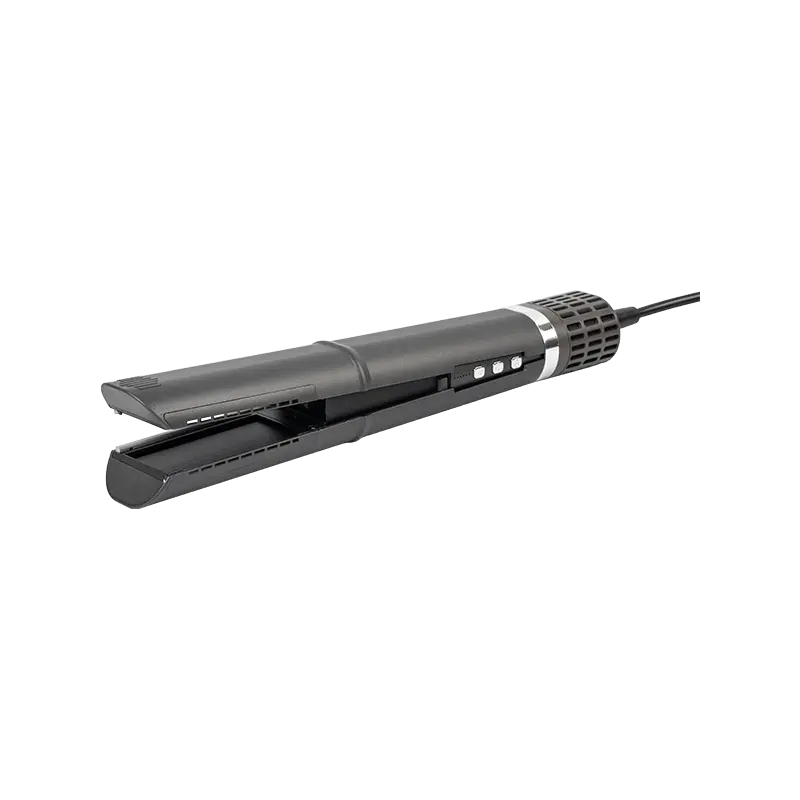
The JYS-C6-B Compact 2-in-1 Wet & Dry Hair Straightener addresses this problem through a combined airflow and straightening system. Instead of treating drying and straightening as two unrelated tasks, the appliance brings them together in one compact styling tool. Its airflow helps remove moisture while the clamp plates guide and smooth the hair, creating a natural, shiny, straight appearance with fewer styling stages.
This product is designed for consumers, retailers, professional distributors, and private-label buyers seeking a practical hair care appliance with a clear point of difference. It combines wet-to-dry capability, elastic hair-protection strips, dual temperature control, a reliable DC motor, double safety protection, optional ionic technology, and a 360-degree swivel cord. These features make it more versatile than a conventional flat iron while remaining simpler and more compact than a separate dryer-and-straightener setup.
1. The Styling Problem Behind the Product
Conventional hair straighteners are generally intended for dry hair. If the hair is still wet, users may need to wait before styling or use a separate dryer first. This adds time and requires two appliances. For many users, especially those preparing for work, school, travel, or daily activities, this extra process is inconvenient.
A conventional hair dryer can remove moisture quickly, but it does not always provide the controlled tension or smoothing effect needed for a straight hairstyle. A traditional straightener can create a sleek finish, but it is normally used only after the hair has been fully dried. The result is a fragmented routine in which drying, brushing, sectioning, and straightening are performed separately.
The JYS-C6-B is designed around a different approach. It uses airflow to assist with moisture removal while the plates guide the hair into a straighter shape. The appliance therefore functions as both a drying tool and a straightening tool. This does not merely add another feature to a standard flat iron; it changes the order and efficiency of the styling process.
For users, the primary benefit is convenience. They can begin with damp hair and use one tool to make progress toward a straight, smooth finish. For buyers and distributors, the product has an easily communicated selling proposition: one compact appliance can reduce the need to carry or purchase both a dryer and a straightener.
2. Product Overview
The JYS-C6-B Compact 2-in-1 Wet & Dry Hair Straightener is a small electrical hair care appliance developed for wet-to-dry styling. It is available in electrical configurations for different markets, including AC 120V operation at 600W and AC 220V–240V operation at 800W, with a frequency range of 50Hz–60Hz.
The appliance uses a DC motor with a stated lifespan of more than 200 hours. It provides one airflow speed and two temperature settings. This control layout is intentionally straightforward. Rather than overwhelming users with numerous settings, it provides basic adjustment for different hair conditions and styling preferences.
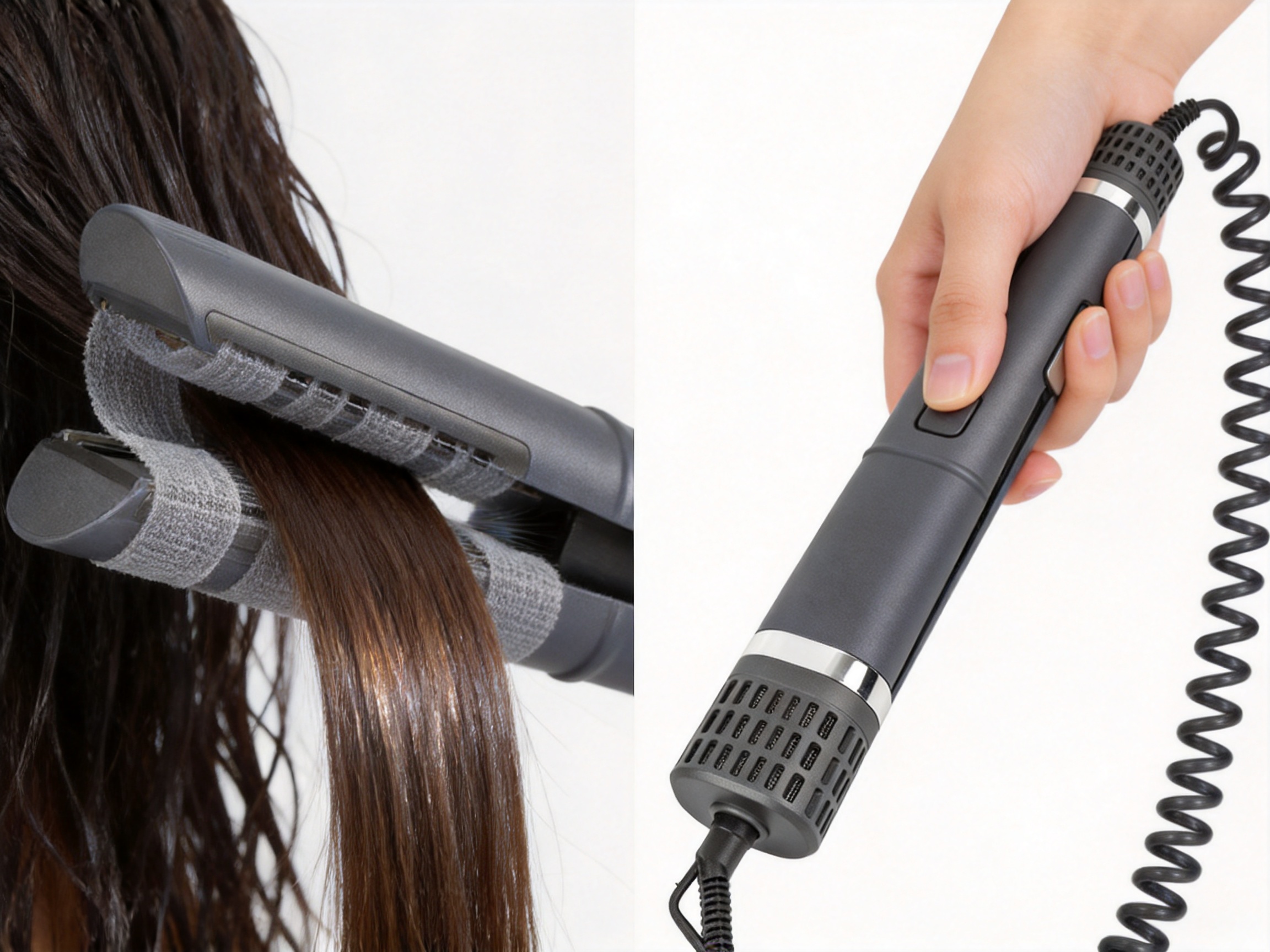
The clamp plates include two elastic protection strips. These movable strips help cushion the hair as it passes through the plates. They are designed to reduce painful pulling, support smoother movement through the hair, and assist in removing water from freshly washed strands. The result is a more comfortable styling experience than a rigid clamp design may provide.
The device also includes double safety protection through temperature control and a fuse. An optional ionic function can be included for versions intended to reduce static electricity and help improve the appearance of frizz-prone hair. A 360-degree rotating power cord supports easier handling and helps reduce cord twisting during use.
Product Attribute |
Specification or Function |
Model |
JYS-C6-B |
Product Type |
Compact 2-in-1 wet-and-dry hair straightener |
Power for 120V Version |
600W |
Power for 220V–240V Version |
800W |
Frequency |
50Hz–60Hz |
Motor |
DC motor with more than 200 hours of stated lifespan |
Airflow Control |
One speed |
Temperature Control |
Two modes |
Protection System |
Temperature control and fuse |
Hair Protection |
Two elastic strips in the clamp plate |
Ionic Function |
Optional |
Power Cord |
360-degree swivel rotation |
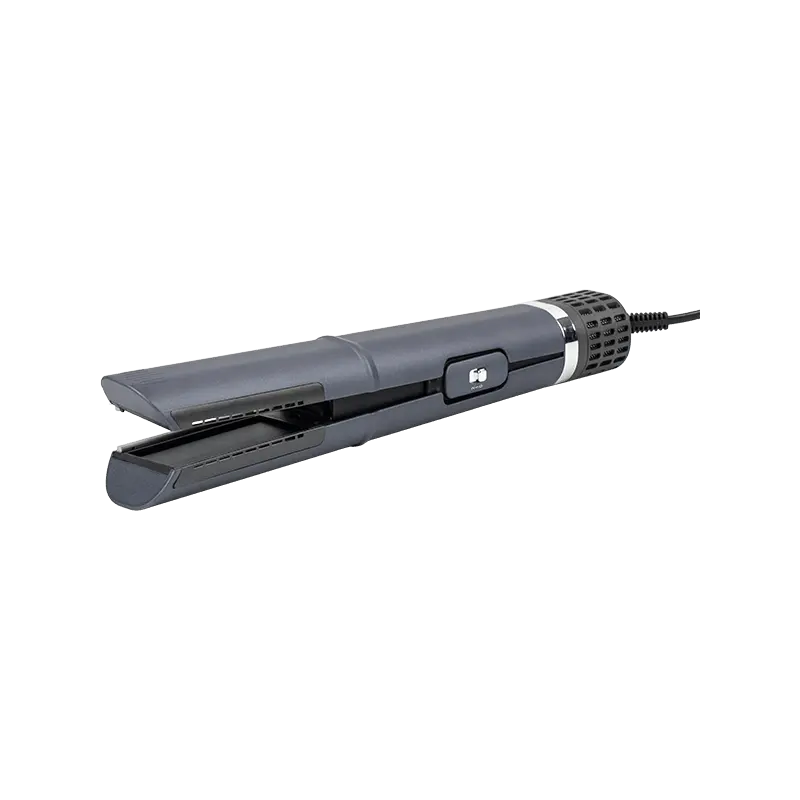
JYS-C6-B Compact 2-in-1 Wet & Dry Hair Straightener
3. How Wet-to-Dry Airflow Straightening Works
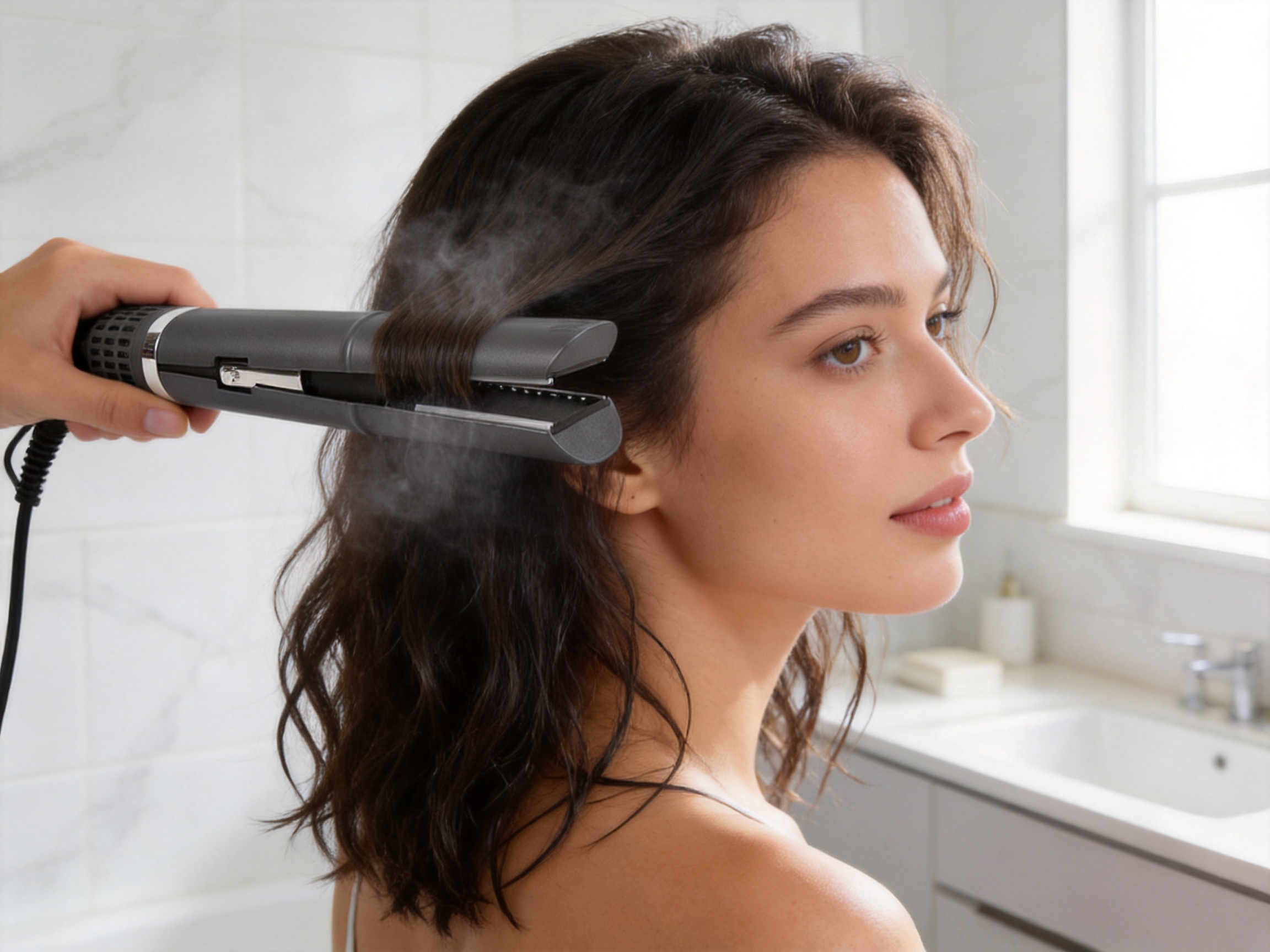
The key innovation of the JYS-C6-B is its ability to combine airflow with straightening movement. When hair is damp, the appliance uses controlled air to assist in drying while the clamp plates guide the hair into a smoother and straighter form. The airflow is intended to remove excess moisture rather than simply trapping wet hair between heated surfaces.
This method offers a practical alternative to using a hot flat iron on hair that has not been properly dried. The air movement helps carry moisture away from the hair, while the plates provide controlled alignment. As the user moves the appliance gradually from the roots toward the ends, the hair can become progressively drier and straighter in the same pass.
Users should still follow appropriate styling practices. Very wet hair should be sectioned and handled patiently rather than pulled through the tool in large amounts. Excess water can be gently removed with a towel before use, and the appliance should be moved continuously instead of being held in one place. These habits support more even results and help reduce unnecessary exposure to heat.
The wet-to-dry design is especially useful for people with straight, wavy, or moderately textured hair who want a smooth everyday appearance. It may also help users who prefer a natural straight finish rather than an extremely compressed, flat-iron effect. Because airflow participates in the drying process, the final appearance can be smooth and shiny while retaining some natural movement.
3.1 A More Efficient Morning Routine
A typical styling routine may involve washing the hair, towel drying it, using a dryer, brushing it, and then applying a straightener. Each transition consumes time. The JYS-C6-B reduces the number of separate tools involved. Users can towel dry excess water, divide the hair into manageable sections, and begin styling with the combined appliance.
This can be valuable for people with demanding schedules. It is also useful in shared bathrooms, hotel rooms, dormitories, and small living spaces where storing several styling appliances is inconvenient. The tool does not eliminate the need for good technique, but it simplifies the equipment required to achieve a polished look.
3.2 A Useful Travel Solution
Travelers often have to choose between packing a hair dryer and a straightener or accepting a less flexible styling routine. A 2-in-1 appliance can reduce luggage volume and simplify packing. The JYS-C6-B is particularly suitable for travel-oriented product lines because it combines two familiar functions in one unit.
Electrical compatibility should always be confirmed before use in a specific country. The available voltage configuration must match the intended market, and an appropriate plug, certification, and packaging solution should be selected for each region. For OEM and ODM buyers, these details can be addressed during product development and market preparation.
4. Elastic Protection Strips and User Comfort
Rigid plates can sometimes pull or catch hair, particularly when users move too quickly, handle thick sections, or work with damp strands. The JYS-C6-B uses two elastic strips in the clamp plate to create a more flexible contact surface. These strips are designed to cushion the hair and support smoother movement through the appliance.
The elastic elements serve several purposes. First, they can make the clamping action feel less harsh. Second, they help reduce the likelihood of painful tugging when the user moves the tool through the hair. Third, they can assist in filtering or pressing out residual water from damp hair during the drying-and-straightening process.
This design gives the product a strong advantage over many basic straighteners that rely only on fixed plates. Instead of treating the hair as a rigid object to be compressed, the appliance introduces a degree of flexibility into the contact area. This supports the product’s broader positioning as a gentler wet-to-dry styling solution.
Hair protection is not determined by one component alone. Users should avoid forcing large sections through the clamp, should select an appropriate temperature, and should keep the appliance moving. Nevertheless, the elastic strips provide an additional mechanical feature that supports comfort and helps distinguish the product in a competitive category.
5. Temperature and Airflow Control
The JYS-C6-B provides one airflow speed and two temperature settings. This simple configuration has several advantages. It is easy to understand, quick to operate, and suitable for consumers who do not want to manage a large number of buttons or controls. The two temperature options allow users to choose a lower setting for finer or more fragile hair and a higher setting for thicker or more resistant hair, subject to appropriate use.
A product with many temperature levels may appeal to professional users, but it can also create confusion for everyday consumers. The JYS-C6-B takes a more focused approach. Its controls cover the essential functions needed for routine wet-to-dry styling without making the appliance difficult to use.
The single airflow speed is similarly practical. The motor provides a consistent flow designed to support drying and straightening. Instead of emphasizing numerous airflow modes, the product focuses on combining airflow with plate movement in a compact format.
Temperature control also contributes to operational safety. The appliance includes internal temperature control and a fuse, creating a double protection system. These elements are intended to help manage heat and interrupt operation if abnormal conditions occur. Users should still follow all instructions, avoid covering air openings, and unplug the product after use.
6. DC Motor Performance
The appliance is equipped with a DC motor with a stated lifespan exceeding 200 hours. The motor is a central part of the wet-to-dry system because it generates the airflow needed to assist with moisture removal. Consistent airflow is important for maintaining predictable performance during repeated styling sessions.
Compared with a basic heated straightener that has no motor, the JYS-C6-B requires an additional internal system to deliver air. The DC motor therefore gives the product its combined dryer-and-straightener identity. It supports a balance between useful airflow, compact construction, and everyday operating simplicity.
The stated motor lifespan is particularly relevant to distributors and private-label buyers. Retailers need products that can support normal household use, while commercial buyers need a clear technical specification for product descriptions, packaging, and sales training. A defined motor specification makes it easier to position the appliance as a functional hair care tool rather than a novelty product.
The JYS-C6-B can also be compared with more advanced models in the same product family. The JYS-C6 uses a BLDC motor, three airflow speeds, nine temperature settings, and higher power. That model is intended for users seeking more professional control. By contrast, the JYS-C6-B is focused on compactness, simplified operation, and accessible wet-to-dry styling. This distinction allows buyers to select the model that best matches their target market.
7. Optional Ionic Technology
The JYS-C6-B can be equipped with an optional ionic function. Ionic hair care appliances are commonly designed to release negative ions that may help reduce static electricity and improve the appearance of frizz. When hair is exposed to airflow and friction, static can make it appear less controlled. Ionic technology may help create a smoother visual finish for suitable hair types.
The ionic function is an option rather than a mandatory configuration. This gives OEM and ODM customers flexibility. A price-focused market may prefer the standard version, while a premium retail line may choose ionic functionality as a value-added feature. Buyers can therefore create different product tiers while retaining the same basic platform.
Ionic technology should be presented accurately. It can support a smoother appearance, but it does not replace proper hair care, conditioning, or suitable styling technique. The final result depends on hair texture, moisture level, section size, temperature, and movement speed. Nevertheless, the optional function can strengthen the product’s appeal to users who specifically look for anti-static or anti-frizz features.
8. 360-Degree Swivel Cord
Hair styling requires movement in multiple directions. Users may rotate the appliance, change hand position, work around the back of the head, or switch between sides. A fixed cord can twist and become restrictive during this process. The 360-degree swivel cord on the JYS-C6-B is designed to reduce this problem.
The rotating connection supports more fluid operation and helps prevent repeated cord tangling. It also makes the appliance easier to maneuver in compact spaces. For retailers, this is a small but meaningful feature because it improves the everyday user experience without adding complicated controls.
Cord design also matters for product presentation. A swivel cord is associated with professional hair tools and can help communicate that the appliance has been designed for repeated styling use. When combined with the wet-to-dry function and elastic strips, it contributes to a more complete set of convenience features.
9. Advantages Over Conventional Straighteners
The most obvious advantage over a conventional straightener is wet-to-dry capability. A standard flat iron normally requires users to dry their hair first. The JYS-C6-B is designed to begin with damp hair and combine drying assistance with straightening. This can reduce the number of appliances and steps needed in the routine.
A second advantage is its airflow-based approach. Conventional straighteners primarily depend on heated plates. The JYS-C6-B adds airflow to help move moisture away from the hair. This creates a styling process that is more integrated and may feel less aggressive than repeatedly applying a high-temperature flat iron to hair that has not been properly dried.
A third advantage is the elastic protection system. Many entry-level straighteners use fixed plates with limited flexibility. The JYS-C6-B includes two elastic strips intended to reduce pulling and improve comfort as hair passes through the clamp.
A fourth advantage is portability. Instead of carrying two appliances, users can carry one compact device for two functions. This makes the product attractive to travelers, students, apartment residents, and consumers who prefer minimal equipment.
A fifth advantage is market flexibility. The product can be offered with or without ionic functionality, and it can be configured for different voltage markets. This supports private-label programs and international distribution strategies.
Comparison Point |
Conventional Hair Straightener |
JYS-C6-B 2-in-1 Appliance |
Starting Hair Condition |
Normally dry hair |
Designed for damp or wet-to-dry styling |
Drying Function |
Usually not included |
Integrated airflow system |
Hair Contact Design |
Typically fixed plates |
Two elastic protection strips |
Equipment Required |
Often requires a separate dryer |
Combines drying assistance and straightening |
Control System |
Varies by model |
One airflow speed and two temperature modes |
Travel Convenience |
May require multiple tools |
One compact multifunction appliance |
Optional Ionic Function |
Depends on model |
Available as an optional configuration |
10. Advantages Over Using a Separate Dryer and Straightener
Using a separate dryer and straightener can deliver excellent results, especially when a user has time and professional styling experience. However, the process usually requires more counter space, more storage, and more coordination. The user may need to hold a brush in one hand and a dryer in the other, then change tools before finishing the style.
The JYS-C6-B simplifies this routine by combining the two principal functions. It does not necessarily replace every professional styling method, but it offers a practical alternative for daily use. It is especially appropriate for people who prioritize efficiency over elaborate styling processes.
The compact design may also reduce the amount of equipment required in a retail bundle. A brand can market the tool as a travel solution, a morning routine product, a starter hair appliance, or a space-saving personal care device. Its value comes from the combination of functions rather than from a single isolated specification.
For consumers, fewer tools can mean fewer cords, fewer storage requirements, and less time spent switching between appliances. For distributors, the combined function creates opportunities for clear packaging claims and product demonstrations. A simple demonstration showing damp hair being dried and straightened can communicate the product concept effectively.
11. Recommended User Procedure
For best results, users should begin by gently removing excess water from the hair with a towel. The hair should be damp rather than dripping. This helps the appliance work more efficiently and reduces the amount of moisture that must be removed during styling.
The hair should then be divided into manageable sections. Smaller sections generally allow the airflow and plates to interact more evenly with the strands. Large sections may require additional passes and can make it harder to achieve a consistent finish.
Users should select the appropriate temperature mode based on hair condition and texture. A lower setting is generally a sensible starting point, particularly for fine or chemically treated hair. Users can increase the setting only when necessary and should avoid leaving the appliance stationary on one area.
The appliance should be placed around a section of hair and moved smoothly from the upper section toward the ends. The movement should be controlled but continuous. Pulling too quickly may produce an incomplete result, while moving too slowly may expose the hair to unnecessary heat.
After each section is completed, users can assess the result before deciding whether another pass is needed. Finishing products may be applied after styling if desired. The appliance should be switched off, unplugged, and allowed to cool before storage.
11.1 Hair Types and Styling Expectations
The JYS-C6-B is suitable for everyday smoothing and straightening of many hair types, particularly straight, wavy, and moderately textured hair. Results will vary according to thickness, curl pattern, porosity, length, and previous chemical treatment.
Very thick or tightly curled hair may require smaller sections and more time. Users should maintain realistic expectations and avoid trying to force the tool to deliver an extremely flat result in a single pass. The product is designed as a practical wet-to-dry appliance, not as a substitute for every high-power professional styling system.
For fine hair, the lower temperature setting and gentle movement can help support a lighter styling approach. For thicker hair, the higher temperature mode may provide more effective control when used carefully. Hair should always be treated according to its condition rather than according to a fixed routine.
12. Safety and Responsible Use
Electrical hair appliances should be used responsibly. The correct voltage version must be selected for the intended market. The appliance should not be operated with damaged cords, cracked housings, blocked air openings, or signs of abnormal heating.
Because the JYS-C6-B is designed for wet-to-dry styling, users may assume that it can be immersed or used in standing water. That is not the case. Wet-to-dry capability refers to damp hair styling, not submersion or use in unsafe water conditions. The appliance should be kept away from bathtubs, sinks, showers, and other sources of water.
The internal temperature control and fuse provide double safety protection, but they do not replace careful operation. Users should keep the appliance moving, avoid covering the airflow openings, and allow the device to cool before placing it in storage. Children should not operate the appliance without suitable supervision.
Retailers and distributors should provide clear instructions in the language of the target market. Packaging should identify the voltage, power, safety warnings, operating method, and care instructions. Correct documentation is particularly important when the product is sold across multiple countries.
13. Manufacturing Strengths and Product Development Capability
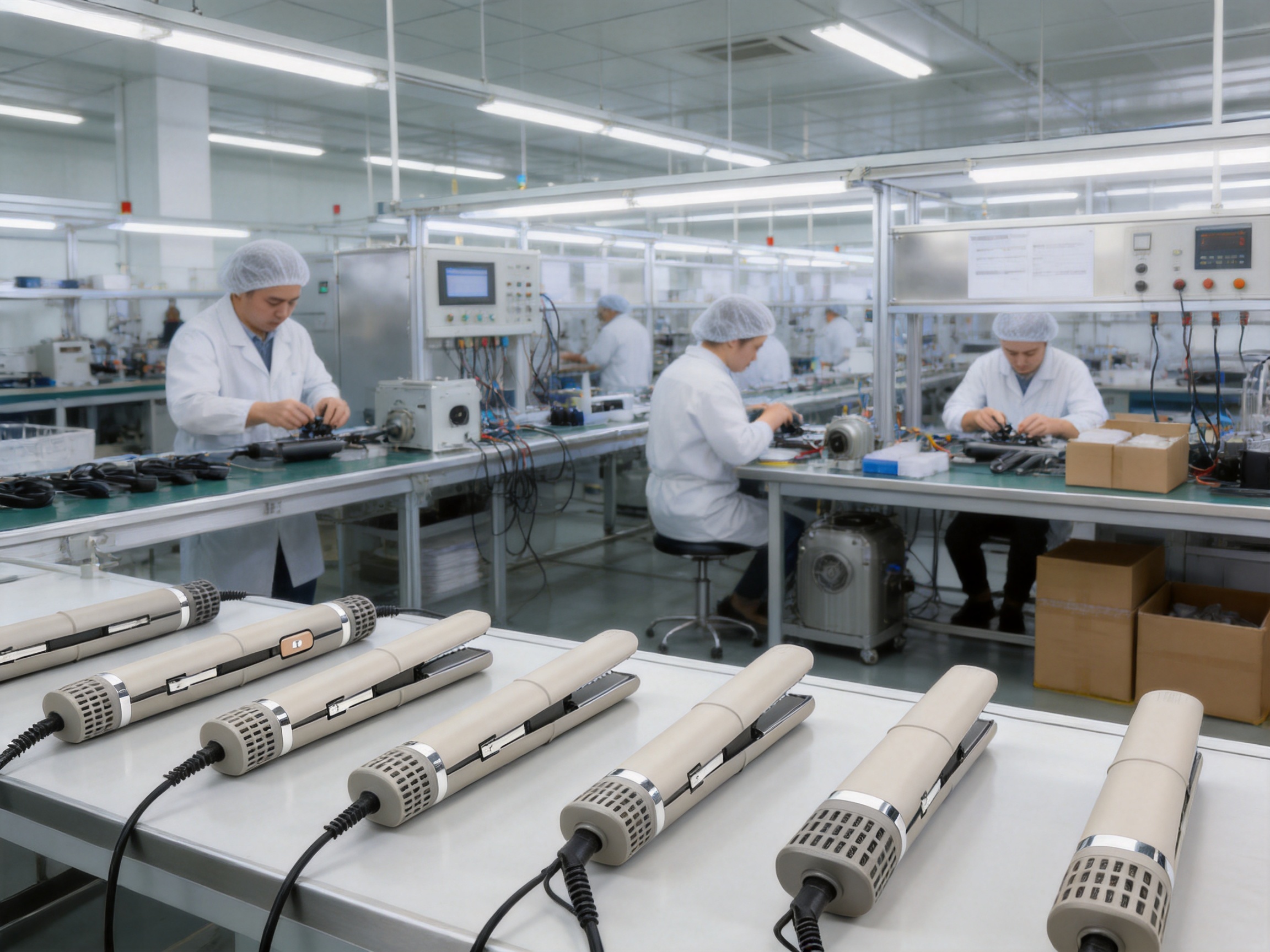
The manufacturer behind this product has specialized in small electrical appliances since 2009. Its business focuses on professional hair care appliances and smart products for healthy living. This specialization supports a deeper understanding of motor systems, heating components, airflow structures, plastic housings, electrical safety, and user-oriented product design.
The company operates a new factory in Shaoxing, Zhejiang Province, while also maintaining the experience associated with its former facility. Its location benefits from developed transportation networks and an established manufacturing environment. These conditions support communication with suppliers, movement of components, production scheduling, and export logistics.
The company has a professional team of more than 140 people and four production lines. Its reported monthly output is approximately 300,000 sets, with annual shipments exceeding three million units. This capacity is important for customers who require stable supply rather than occasional small-batch production.
Production scale can provide several commercial advantages. It may support more consistent component purchasing, better production planning, faster response to repeat orders, and the ability to accommodate different product programs. A factory with multiple production lines can also manage a broader portfolio of hair dryers, curlers, straighteners, ionic brushes, and other small electrical appliances.
13.1 OEM and ODM Support
The company provides both OEM and ODM services. OEM customers can develop products under their own brand identity while selecting suitable configurations, packaging, colors, and market requirements. ODM customers can use existing platforms or cooperate on product adaptations and new designs.
For the JYS-C6-B platform, OEM and ODM discussions may include voltage selection, plug type, color, surface finish, packaging structure, branding, instruction manuals, ionic configuration, and target-market certification requirements. These options allow buyers to create a product that fits a specific retail channel rather than offering a completely generic appliance.
Effective OEM and ODM production requires coordination between engineering, procurement, production, quality control, documentation, and logistics. A manufacturer with experience in international customer cooperation is better positioned to manage these stages. The company’s history of serving recognized customers in different markets provides relevant experience in product consistency and delivery expectations.
13.2 Production Process Considerations
Although individual production procedures may vary by order and configuration, a professional hair appliance manufacturing process generally includes product design review, component sourcing, incoming material inspection, assembly, electrical testing, functional testing, appearance inspection, aging or reliability checks, final packing, and shipment preparation.
For a wet-to-dry straightener, particular attention is required for the airflow path, motor installation, heating elements, clamp alignment, elastic strips, power cord connection, insulation, temperature control, and fuse protection. These parts must work together within a compact housing. Poor alignment or inconsistent assembly could affect airflow, hair movement, heat distribution, or user comfort.
Quality control should therefore address both electrical and mechanical performance. Electrical checks can verify power consumption, insulation, leakage-related safety requirements, switch function, temperature behavior, and fuse response. Mechanical checks can examine plate movement, cord rotation, housing fit, airflow openings, and the resilience of the elastic strips.
Appearance inspection is also important for branded products. Surface marks, uneven color, poor printing, loose components, or packaging damage can affect the customer’s perception even when the appliance functions correctly. A mature manufacturing system recognizes that product quality includes reliability, appearance, documentation, and delivery condition.
14. Certifications, Audits, and International Market Readiness
The company’s main products have obtained international certifications and compliance-related approvals including TUV GS, CE, CB, ERP, REACH, PAHS, ROHS, and SCCP. The exact applicability of each certification depends on the product configuration and destination market, so buyers should confirm the relevant documentation for a specific order.
These certifications and standards are important because electrical hair appliances are sold in markets with different technical, environmental, and chemical requirements. Compliance supports safer market entry and helps importers prepare their product files, declarations, labels, and retail documentation.
The factory has also successfully passed BSCI and BEPI audits. These audits are relevant to customers evaluating social responsibility, environmental management, workplace practices, and supply-chain expectations. For international brands, factory audit performance can be an important part of supplier selection.
Compliance should be treated as an ongoing process rather than a one-time marketing statement. Product changes, component substitutions, voltage variations, and destination-market requirements may affect testing and documentation. OEM and ODM buyers should work with the manufacturer early in the development process to identify the correct approval pathway.
15. International Customer and Export Experience
The company’s products are exported to more than 30 countries and regions. International experience can help a manufacturer understand differences in plug systems, voltage, labeling, packaging, language, retail expectations, and after-sales support.
The company has maintained long-term cooperation with internationally recognized customers, including ALDI, ELLE, COSMOPOLITAN, and TRISTAR. Such cooperation indicates experience with structured purchasing processes, product review, quality requirements, and ongoing supply arrangements. It also demonstrates the ability to support both retail-oriented and brand-oriented product programs.
For buyers considering the JYS-C6-B, export experience can reduce some of the practical challenges involved in launching a hair appliance in a new market. The manufacturer can support discussions concerning configuration, documentation, packaging, production capacity, and delivery planning. Buyers should still conduct their own due diligence, including sample evaluation and market-specific compliance confirmation.
16. Sustainability and Responsible Manufacturing
Small electrical appliances require attention to energy use, material selection, product lifespan, packaging, and responsible factory operation. A product that combines two functions may reduce the need for consumers to purchase and transport separate appliances, although the overall environmental impact depends on usage, durability, repairability, packaging, and end-of-life treatment.
The company’s stated certifications and audits include environmental and chemical compliance areas. REACH, ROHS, PAHS, and SCCP-related requirements are relevant to restricted substances and responsible material management. Energy-related requirements such as ERP may also be relevant depending on the applicable product category and market.
Manufacturing responsibility extends beyond the product itself. Factory audits such as BSCI and BEPI address broader questions related to workplace conditions, social responsibility, and environmental practices. These considerations are increasingly important for retailers and brands that publish supplier standards or sustainability policies.
OEM and ODM buyers can further improve the product program by discussing packaging optimization, reduced use of unnecessary materials, recyclable packaging options, instruction manual efficiency, and appropriate spare-part planning. These decisions should be evaluated alongside safety, durability, protection during transport, and customer communication.
17. Commercial Applications
The JYS-C6-B can serve several retail and commercial positioning strategies. It may be sold as an everyday home styling tool for consumers who want a quicker morning routine. It can also be positioned as a travel appliance for customers who want to reduce the number of devices packed in a suitcase.
Beauty retailers may emphasize its wet-to-dry function and elastic protection strips. Department stores may present it as a convenient multifunction personal care appliance. Online sellers can demonstrate the airflow and straightening process through video content, while private-label brands can use the optional ionic function to create a premium variation.
The product is also appropriate for promotional programs, seasonal gift sets, and lifestyle-oriented product ranges. Its combined function is easy to explain, and its compact format supports product bundles with heat-protection sprays, storage pouches, combs, or other hair care accessories, depending on the buyer’s strategy.
17.1 Suitable Target Customers
Busy professionals may appreciate the reduced number of styling steps. Students and travelers may value the space-saving design. Consumers with small bathrooms may prefer one multifunction appliance instead of two separate devices. Users concerned about pulling and hair discomfort may be attracted to the elastic protection strips.
Retailers targeting value-conscious consumers can focus on functionality and convenience. Premium brands can select the ionic option, customized colors, refined packaging, and additional accessories. Professional distributors can present the model as an accessible wet-to-dry alternative alongside more advanced products such as high-power BLDC motor models.
18. Product Positioning Against Higher-Specification Models
Not every customer needs the highest motor power or the largest number of settings. A high-performance professional appliance may offer three airflow speeds and nine temperature levels, but it may also be larger, more complex, and more expensive. The JYS-C6-B is positioned differently.
Its strengths are compactness, straightforward control, wet-to-dry functionality, and practical protection features. One airflow speed and two temperature modes are enough for users who want a simple daily tool. The DC motor supports the integrated airflow function while keeping the product concept accessible to a broad consumer group.
This creates a useful product ladder for brands and distributors. The JYS-C6-B can serve as the compact and approachable model, while more powerful BLDC motor products can serve professional or premium customers. Offering multiple levels allows a company to address different price points without confusing the core identity of each product.
19. Maintenance and Product Care
Regular care can support consistent performance. Users should keep the airflow openings free from dust, hair, and styling-product residue. The exterior can be cleaned with a soft, dry or slightly damp cloth after the appliance has been unplugged and cooled. Water should never be poured into the housing.
The clamp plates and elastic strips should be checked periodically for accumulated residue. If product buildup is present, it should be removed carefully according to the instruction manual. Harsh abrasives or sharp tools should not be used because they may damage the surface or flexible components.
The power cord should be stored without tight kinks. Although the cord has a 360-degree swivel connection, it should not be wrapped forcefully around the appliance. The product should be stored in a dry location away from direct heat and moisture.
For distributors, after-sales documentation should explain these maintenance steps clearly. Good user guidance can reduce preventable complaints and help customers understand the difference between wet-to-dry styling and unsafe use near water.
20. Q&A: Common Questions About the Product
Q1. Can the JYS-C6-B be used on wet hair?
Yes. The appliance is specifically designed for wet-to-dry styling and uses airflow to assist in drying while the plates straighten the hair. Users should remove excess water first so that the hair is damp rather than dripping and should follow the recommended operating instructions.
Q2. Does it replace both a hair dryer and a straightener?
It combines the primary functions of drying assistance and straightening in one appliance. It is designed to reduce the need for separate tools during everyday styling. Professional users may still choose a separate high-power dryer for specialized techniques or very intensive drying requirements.
Q3. How do the elastic strips protect the hair?
The two elastic strips in the clamp plate provide a more flexible contact surface. They are designed to cushion the hair, reduce painful pulling, and help remove residual water as the hair passes through the appliance.
Q4. How many airflow and temperature settings does it have?
The JYS-C6-B has one airflow speed and two temperature modes. This configuration provides simple control for everyday use while keeping the operating interface easy to understand.
Q5. Is ionic technology included?
Ionic technology is available as an optional function. Buyers can discuss this configuration with the manufacturer when developing a specific OEM, ODM, or retail version.
Q6. What motor does the product use?
The JYS-C6-B uses a DC motor with a stated lifespan exceeding 200 hours. The motor provides the airflow required for its wet-to-dry styling function.
Q7. How does the JYS-C6-B differ from the JYS-C6?
The JYS-C6-B uses a DC motor, one airflow speed, two temperature settings, and 600W–800W power depending on voltage. The JYS-C6 uses a more powerful BLDC motor, three airflow speeds, nine temperature settings, and 1200W–1400W power. The JYS-C6-B is focused on compact, simplified everyday styling, while the JYS-C6 is designed for users seeking more advanced control and higher performance.
Q8. Is the appliance suitable for travel?
Its 2-in-1 format can make it convenient for travel because one device provides drying assistance and straightening. Travelers must confirm that the voltage configuration and plug type are suitable for the destination country.
Q9. Does the product eliminate heat exposure?
No. The appliance still uses controlled heat as part of the styling process. Its airflow system is intended to support drying and reduce reliance on a separate tool, while the user remains responsible for selecting an appropriate temperature and using suitable technique.
Q10. What safety protection is included?
The product includes temperature control and a fuse, described as a double safety protection system. Users should also follow all operating instructions, keep the appliance away from standing water, and unplug it after use.
Q11. Can brands customize the product?
OEM and ODM services are available. Customization discussions may cover branding, color, packaging, voltage, plug type, manuals, ionic configuration, and other market-specific requirements, subject to technical and order conditions.
Q12. What manufacturing support is available?
The manufacturer has more than 140 professional employees, four production lines, monthly output of approximately 300,000 sets, and annual shipments exceeding three million units. It provides product development, OEM and ODM support, production coordination, quality management, and export experience.
21. Final Assessment
The JYS-C6-B Compact 2-in-1 Wet & Dry Hair Straightener is built around a clear consumer need: making hair styling faster without requiring separate drying and straightening appliances. Its integrated airflow system, wet-to-dry capability, elastic protection strips, two temperature modes, double safety protection, optional ionic function, and swivel cord give it a distinctive position in the hair tools market.
Its strongest advantage is not one isolated specification but the way multiple practical features work together. Airflow assists with drying, the plates guide the hair, elastic strips support comfort, and the compact body reduces equipment requirements. The simple one-speed, two-temperature control system makes the product accessible to everyday users, while the optional ionic configuration gives brands room to create differentiated versions.
From a sourcing perspective, the manufacturer adds value through long-term small-appliance experience, dedicated hair care expertise, international certifications, factory audits, OEM and ODM capability, substantial production capacity, and export experience across more than 30 countries and regions. These strengths make the product suitable for retailers, distributors, private-label brands, and companies seeking a reliable multifunction hair care platform.
For consumers, the appliance offers a convenient path from damp hair to a smoother, straighter style. For commercial buyers, it provides a strong product story supported by functional design and scalable manufacturing. With correct market configuration, careful user guidance, and responsible quality management, the JYS-C6-B can serve as a practical and competitive addition to a modern hair tools portfolio.
References
1. Product specification materials for the JYS-C6-B Compact 2-in-1 Wet & Dry Hair Straightener.
2. Manufacturer-provided technical information covering voltage, power, motor, airflow, temperature, safety, cord, and ionic configurations.
3. Manufacturer-provided information regarding OEM and ODM product development services.
4. Manufacturer-provided company profile covering production capacity, export markets, certifications, and factory audits.
5. General consumer guidance for the safe operation and maintenance of electrical hair styling appliances.


 English
 Español